
FTX distributions in Tunisia: payouts are frozen in 2026, sell your FTX claim
Tunisia is on FTX’s restricted jurisdictions list of 30 Oct 2026: no provider serves it, so allowed claims of creditors living in Tunisia are not being paid. This page explains the Tunisian context, the deadlines that run anyway and how to sell your claim to Reclaim Capital for USDT, USDC or USD.
 Reply within 24 hoursPaid in USDT · USDC · USDNotice of Transfer filed in court…days
until the 5th-round deadline
Sources: FTX Support restricted list (30 Oct 2026); Bahamas list of FTX Digital Markets (PwC), which also names Tunisia; Tunisian foreign-exchange law No. 76-18 of 1976 and the 2026 Finance Law amendment (Dec 2025). Not legal advice.
Why Tunisian creditors are not being paid
Distributions reach creditors only through providers chosen by FTX (BitGo, Kraken or Payoneer), and each runs its own KYC. For Tunisia none of them is available, which is why the country appears among the 43 jurisdictions on the FTX restricted list of 30 October 2026, as well as on the Bahamas list of FTX Digital Markets.
FTX gives no reasons, but the Tunisian setting is tight: the dinar is not freely convertible, foreign-exchange operations fall under Law No. 76-18 of 1976, and crypto-assets have no authorised status in the country. In December 2025 parliament voted, in the 2026 Finance Law, to let Tunisian residents open foreign-currency accounts without prior approval of the Central Bank of Tunisia; how this works in practice depends on the implementing rules.
The 2025 amendment leaves the details to the Central Bank of Tunisia, which has to issue the rules for the new foreign-currency accounts. A new Foreign Exchange Code is still at the draft stage. Until it is adopted, Law No. 76-18 remains the basic text for foreign-exchange operations in Tunisia.
Your eligibility is decided by the residential address in KYC: a Tunisian living in Germany can be paid, a foreign resident of Tunis or Sfax cannot.
Our article No FTX distribution provider for your country lists what to ask FTX support; the FTX claim tracker shows where your claim stands.
Deadlines that run while you wait
The fourth FTX distribution (31 March 2026) paid about $2.2 billion; the fifth started on 31 July 2026 with about $900 million. Under FTX rules, a creditor who has not onboarded with a provider within six months of a distribution date may lose the right to distributions on the claim; after the fifth round that window closes roughly on 31 January 2027. More in our articles on the fifth FTX distribution and on a missed distribution.
A creditor in Tunisia cannot meet that condition: there is nobody to onboard with. Meanwhile the claim may be marked Disputed as an ineligible jurisdiction, and it is not yet known how the court will treat such claims; we follow this in our article on the extended objection deadline.
Easier currency rules at home will not by themselves open an FTX payout channel. A sale replaces an open-ended wait with a fixed amount paid now, and the buyer takes over the procedure.
Key dates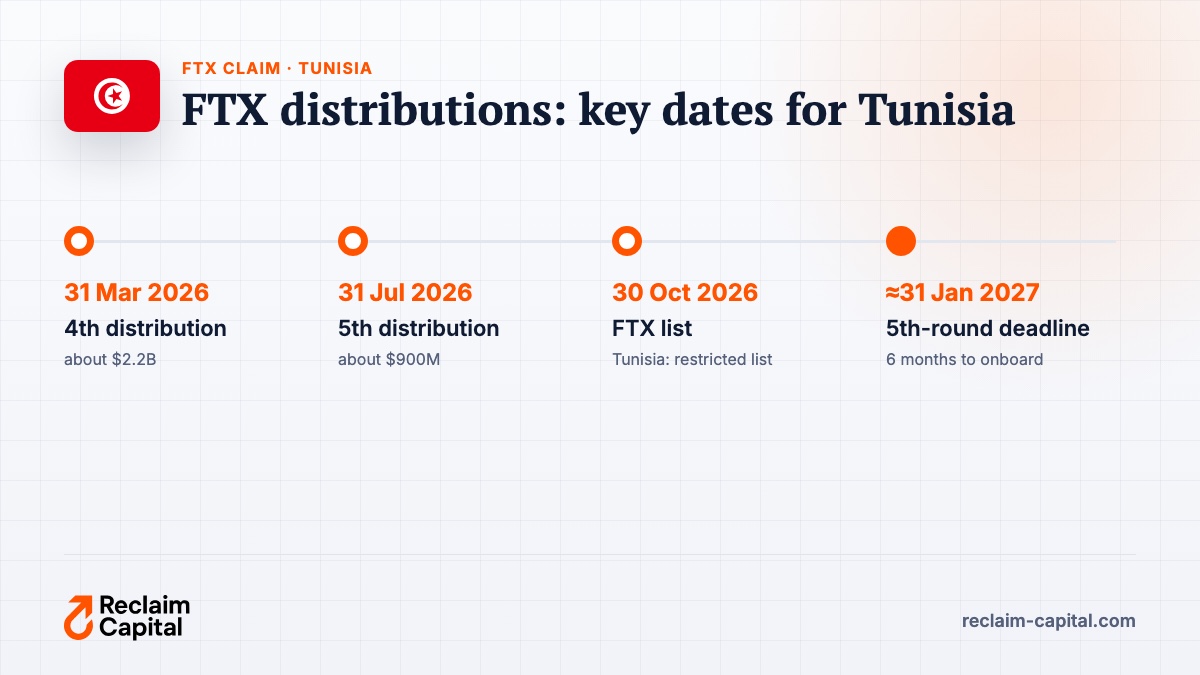
Selling a Tunisian FTX claim step by step
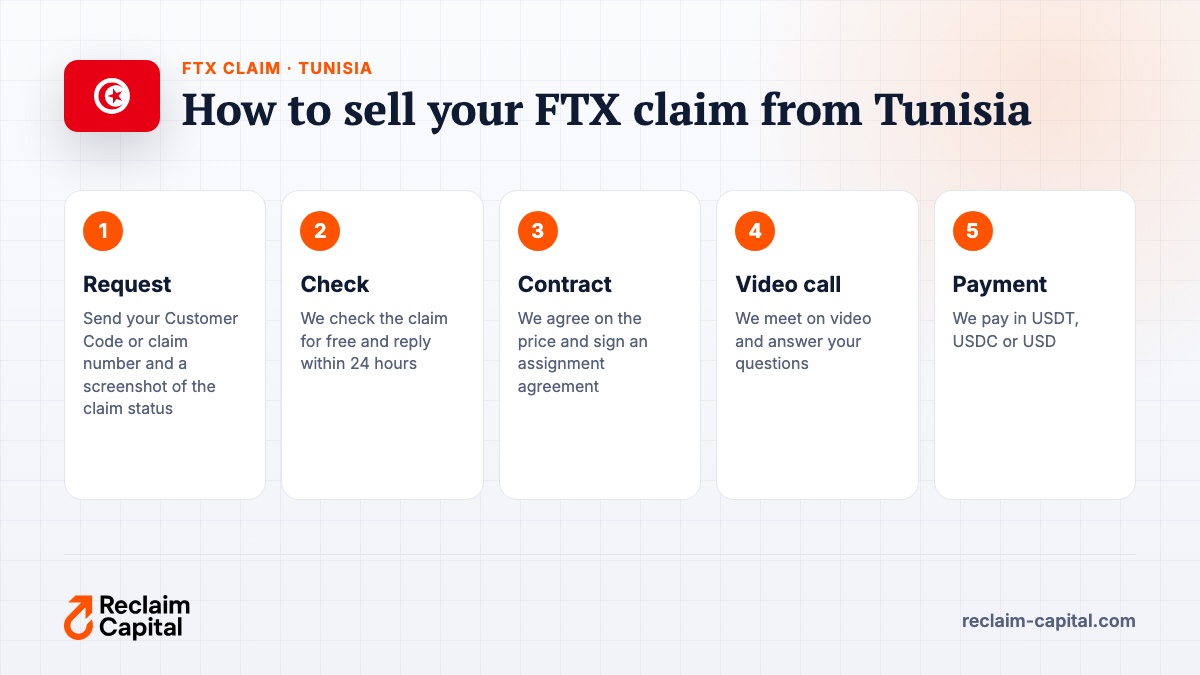
- RequestShare your Customer Code or claim number and a screenshot of the claim status from the FTX portal.
- CheckWe review the claim free of charge and answer within 24 hours.
- ContractPrice and terms go into an assignment agreement that you can read in advance.
- Video callYou talk to the team on video before the deal is closed.
- PaymentYou receive USDT, USDC or, in some cases, USD on the date set in the contract.
Video: how to sell an FTX claim from a restricted-list country
How the price of a claim is set
The claim amount was fixed in US dollars at the FTX bankruptcy date (November 2022); today’s dinar rate does not change it.
Because the dinar cannot be freely converted, Tunisian creditors often ask how they would receive dollars at all. Settlement in USDT or USDC goes to a wallet you control; whether and how you convert it afterwards is governed by Tunisian rules, which we recommend checking with an adviser.
Sellers in Tunisia can identify themselves with the national identity card (CIN) or a passport. A stablecoin payment does not pass through a Tunisian bank and does not require a dinar account. If you later want to keep the money in a foreign-currency account at home, ask your bank how the new rules apply to funds of this origin. Keep the contract and the payment record, since a bank or adviser may ask where the funds came from.
We look at the amount, the status (Allowed or Disputed), what has already been paid out and the documents you have, and make a concrete offer after a free check. You are not obliged to accept it.
If you collect several offers, compare who pays, when and under which contract, not just the percentage.
Safe buyers: what to check in Tunisia
Everything below can be checked independently, before you send us a single document.
Be wary of Facebook pages or Telegram accounts that promise to “release” a blocked FTX payout for a fee: nobody can unblock a restricted jurisdiction, and a real buyer pays you, not the other way round.
We take no prepayment or fees, and the check is free. You can have a video call with the team before signing. The claim transfer is formal: a Notice of Transfer is filed on the bankruptcy docket and Kroll validates it. We explain how to check us yourself on the page How to verify Reclaim Capital.
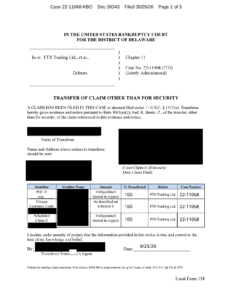 Transfer of ClaimTransferredView a sample (PDF) ↗
Oleh Chubai
Before signing, ask for the full name of the counterparty, its registration details, the price and the payment terms, and check them against the agreement.

Check your case in 30 seconds
What is your claim status in the FTX portal?
FAQ
Will I receive FTX payouts while I live in Tunisia?
Not while Tunisia remains on the list. Tunisia is on the FTX restricted list of 30 Oct 2026 with no provider, and FTX has postponed these distributions without a date. A new provider would appear on the list and in your portal.
Does the new foreign-currency account rule help with FTX?
No. It concerns Tunisian bank accounts, while FTX payouts depend on a provider that accepts Tunisian residents. None does at the moment.
Crypto has no authorised status in Tunisia. Is that a problem?
That is a question of Tunisian law, and we do not give legal advice. We agree the settlement method before signing, and in some cases payment in USD is possible. Please check your own situation with a local adviser.
I am Tunisian but live in Europe. What applies to me?
Your KYC address decides. If it is in a country with a provider, you can claim the distribution yourself; selling is still an option if you want the money sooner.
Is selling an FTX claim legal?
Yes. Claim transfers are standard practice in US Chapter 11 bankruptcies: a notice of transfer is filed with the court, Kroll validates it, and there are 21 days for objections.
Which documents do sellers from Tunisia provide?
The Customer Code or claim number, a screenshot of the status and ID: a passport or the Tunisian national ID card (CIN). We send the complete list after the first check, and our article on documents to sell an FTX claim helps you prepare.
Do you charge upfront fees?
No. The check is free, with no fees and no prepayment.
How long does a sale take for a seller in Tunisia?
After the free check, the timing depends on your claim and your documents. The steps and the payment date are written into the contract before you sign, so there are no open-ended promises.
Get a free claim check
Reply within 24 hours
- No fees and no prepayment
- Payment in USDT, USDC or USD
- Each case is reviewed individually

