

1. What exactly the FTX trust is asking for
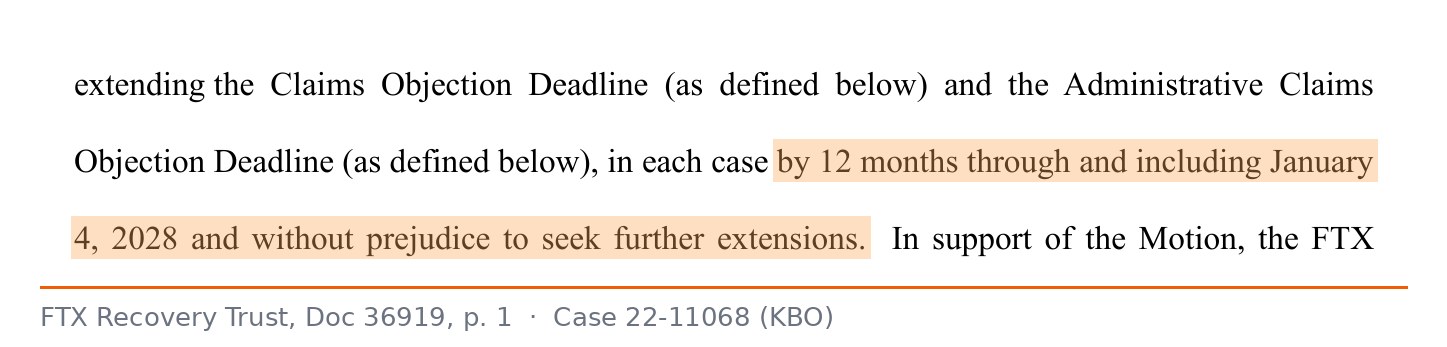
Under the FTX plan of reorganization, the trust can object to claims only until a set date called the Claims Objection Deadline. After that date a claim can no longer be challenged. Originally the deadline fell one year after the plan's effective date, on January 3, 2026. In November 2025, the court extended it to January 4, 2027. Now the trust is asking for another 12 months. The same extension is requested for administrative claims.
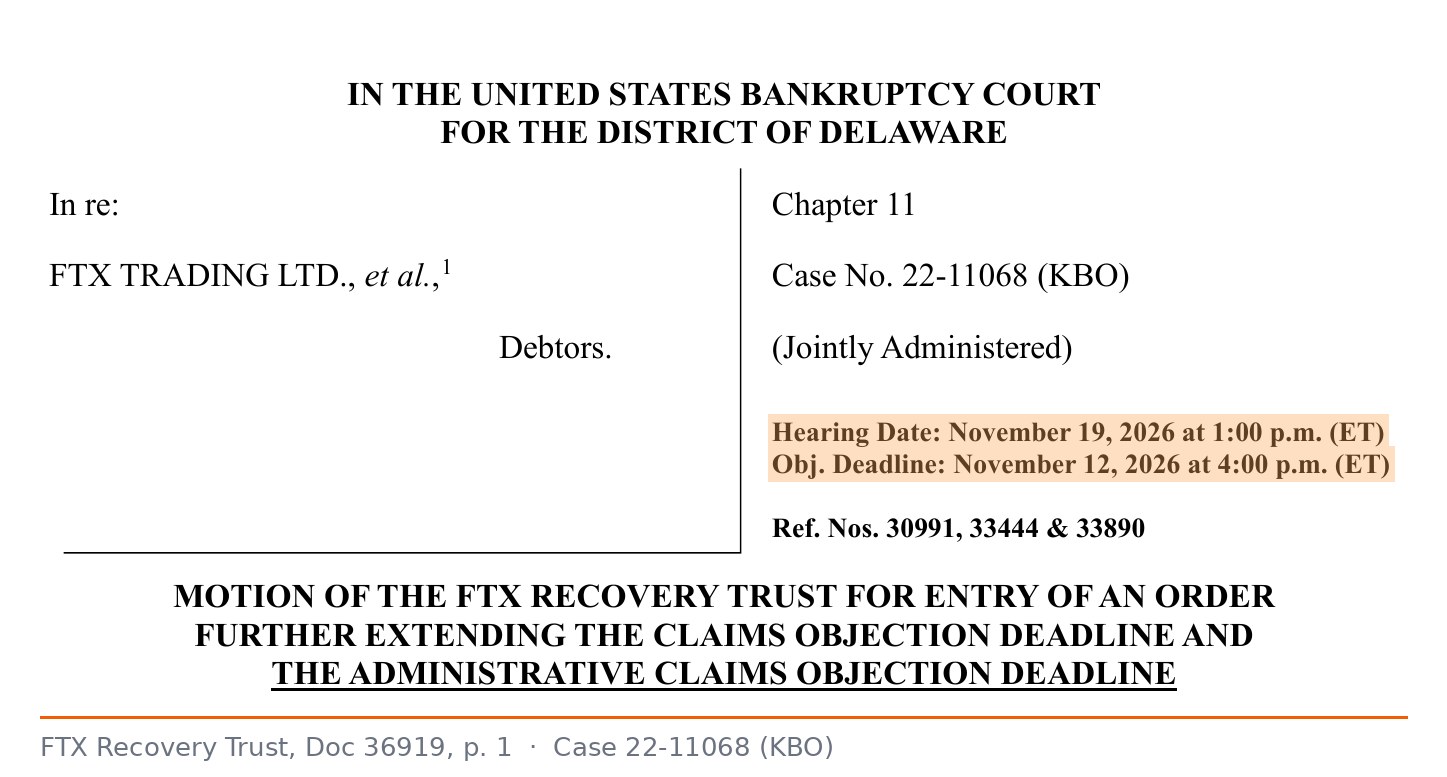
- Jan 3, 2026under the plan
- Jan 4, 2027first extension
- Jan 4, 2028requested now
2. The numbers: 2% of FTX claims hold $25 billion
The most interesting part of the document is hidden in the fourth paragraph. At the start of the case, more than 682,000 claims totaling over $447 billion were filed against FTX. About 13,800 of them are still under review, but their total asserted amount is almost $25 billion.
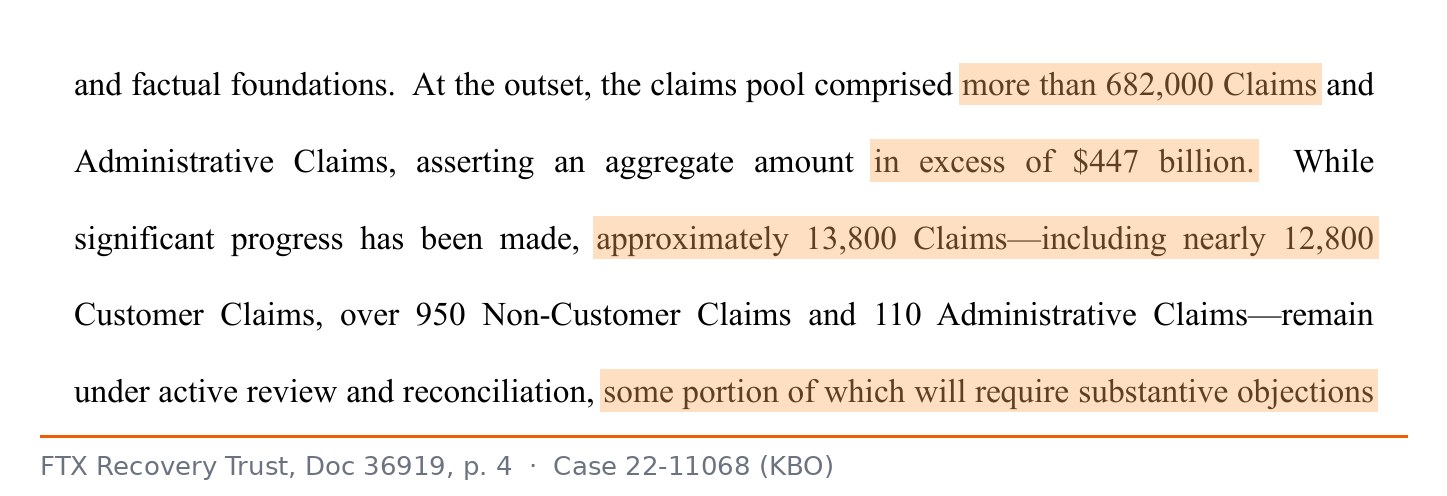
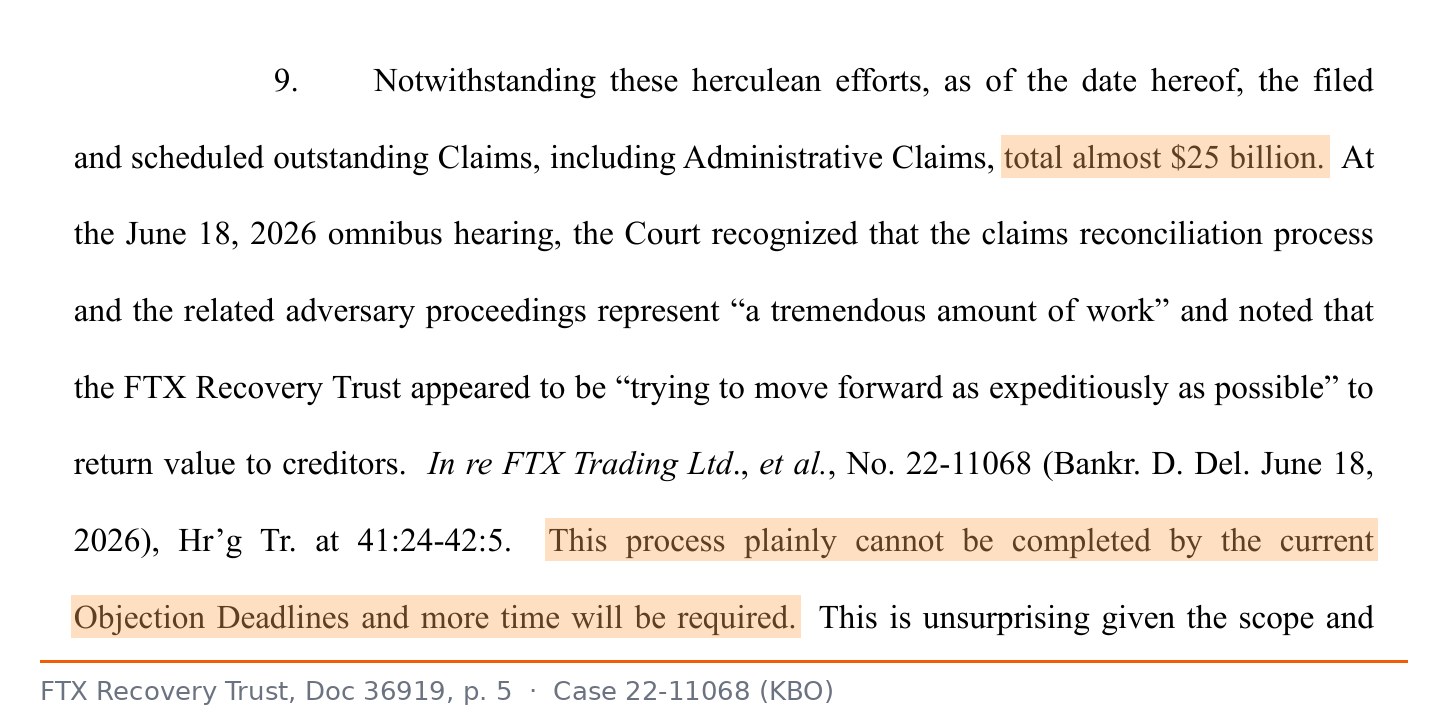
Let us do the math. At the start of the case, the average asserted claim was about $655,000. Among the remaining claims the average is already about $1.8 million, almost three times higher. The trust has mostly resolved the simple claims, and what is left are the large and complex ones.
The pace can also be seen in the document. Since November 2025, the trust has resolved about 11,500 claims, filed six new omnibus objections (204 in total) and made two distributions worth about $3.1 billion.
If the trust keeps last year's pace, the remaining 13,800 claims will take a little over a year. That matches the requested deadline of January 2028. But the remaining claims are larger and more complex on average, so the pace may slow down. This is our estimate: the trust does not give a completion date.
3. “Dozens of complex claims worth billions”: who could they be
Another important phrase is on page eight. The trust writes that the remaining claims include “dozens of complex claims” that require fact-finding and involve billions of dollars. Some of them involve “intercreditor disputes”.
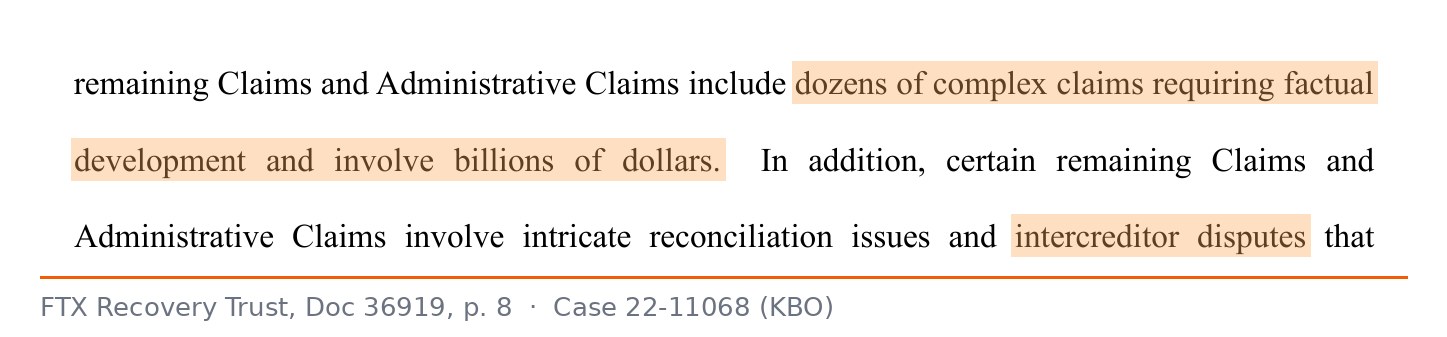
The document names no names. In our view, in large bankruptcies such claims usually belong to institutional creditors, parties related to the debtor and counterparties in ongoing litigation. The trust also mentions that it is pursuing "dozens" of lawsuits.
In our view, for an ordinary FTX customer this means most of the time goes not into their claim but into a few large disputes. Until they are resolved, the trust holds reserves for the disputed amounts. That determines how much money can go into the next distributions.
4. Will 2028 be the final deadline
The trust explicitly reserves the right to ask for new extensions. To show that this is normal practice, it cites examples of other Delaware bankruptcies in the motion itself.
Source: FTX Recovery Trust motion, docket 36919, p. 9. FTX extensions: the first (November 2025) and the new one (November 2026, pending)
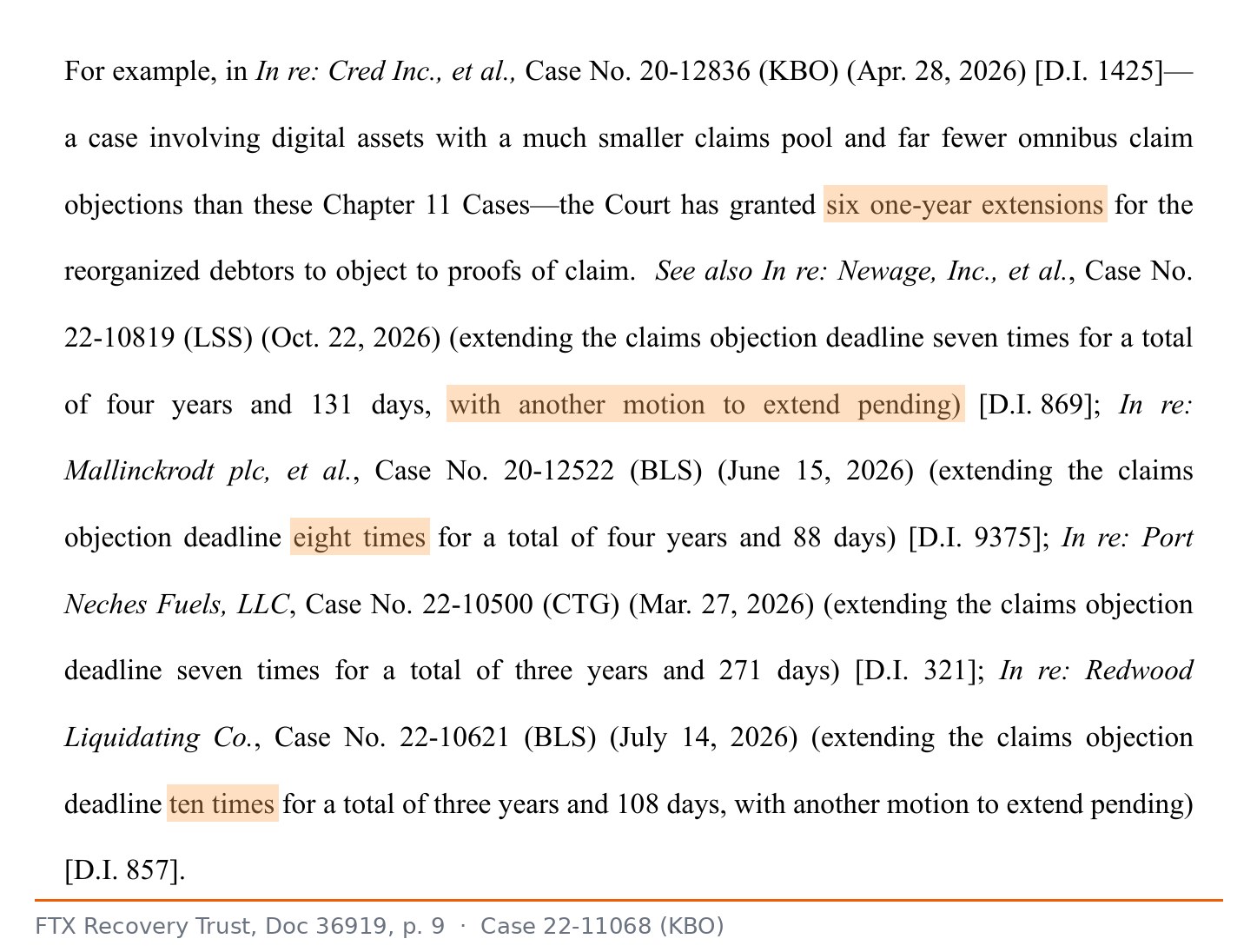
In our view, the choice of examples says a lot. If the trust compares FTX with cases where deadlines were extended six, eight and ten times, January 2028 is hardly worth treating as the final date. The trust may well meet it. But it is wise to plan with a margin.
One more observation. Every additional year of review means the administrative and legal costs of the process keep growing, and holders of claims that are not yet allowed wait the longest. The motion gives no cost figures: this is our reading of how such processes usually go.
5. The trust's arguments and the court's position
To be fair, here is the trust's position. It writes that the extension is not meant to delay anything. Without it, unfounded claims could be paid, which would reduce distributions to all other creditors. The alternative, according to the trust, would be to file a huge number of premature objections at once, overloading both the court and the creditors themselves.
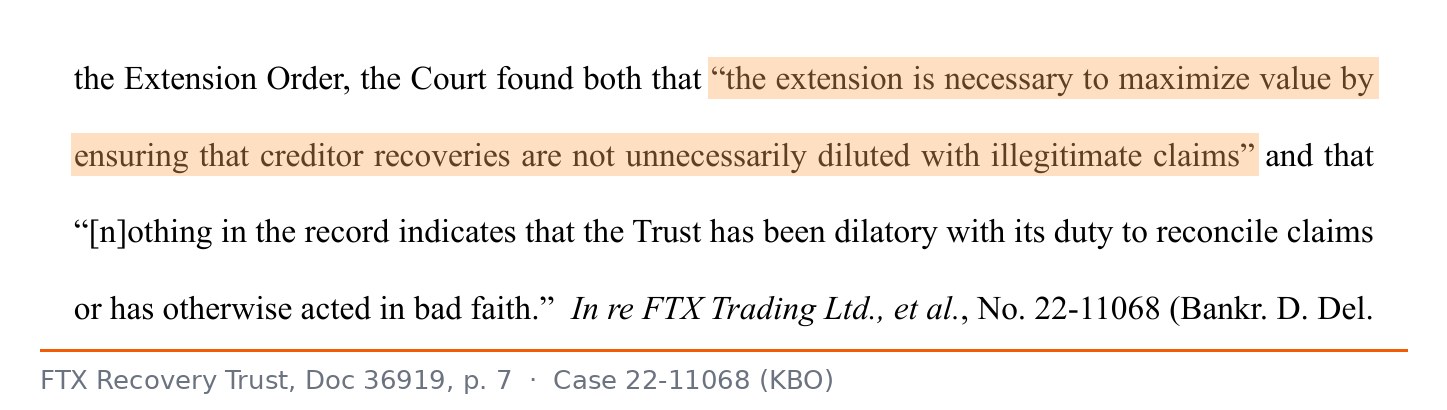
“The extension is necessary to maximize value by ensuring that creditor recoveries are not unnecessarily diluted with illegitimate claims.”
FTX bankruptcy court, November 24, 2025, quoted in docket 36919, p. 7The court also found at the time that “nothing in the record indicates that the Trust has been dilatory with its duty to reconcile claims or has otherwise acted in bad faith.” A year ago the court approved the extension. The ruling will most likely be similar now, but only the court will decide on November 19.
6. Who the extension affects: allowed, disputed and restricted FTX claims
Nothing directly. The motion changes neither distribution percentages nor payment dates.
If the court agrees, the trust can object to your claim at any time until January 4, 2028.
The dispute may last longer. It is important to respond to the trust's objections on time.
The document says nothing about it. If the claim is allowed, the problem is receiving the payment, not the objection. If it is not allowed, the uncertainty will last longer.
If your country has no distribution provider, we covered this situation in detail in "FTX: no distribution provider for your country". If a payment has not arrived, start with our guide "FTX payment not received: what to check". The schedule of past distributions is collected in "FTX creditor distributions in 2026".
How to check the status of your claim
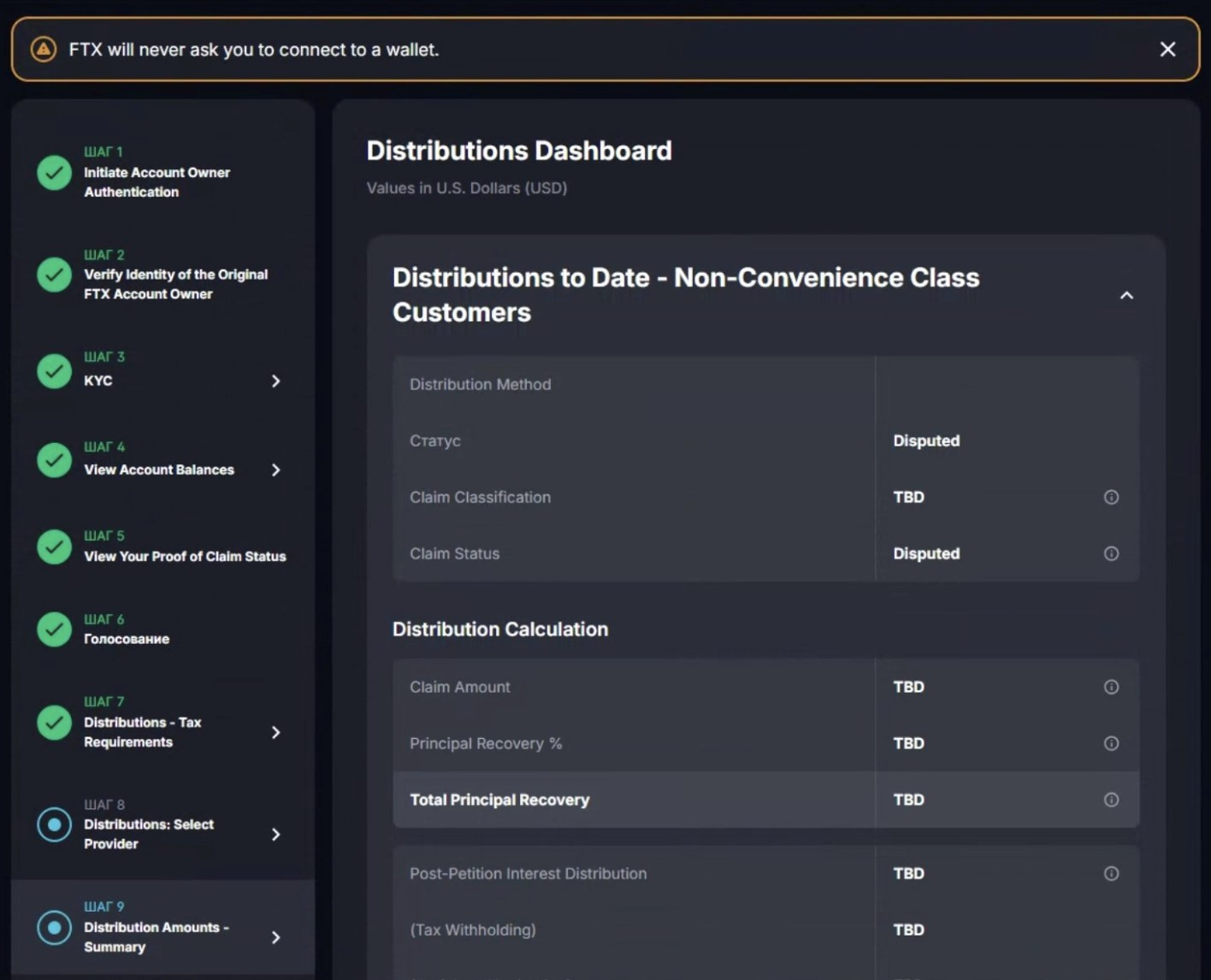
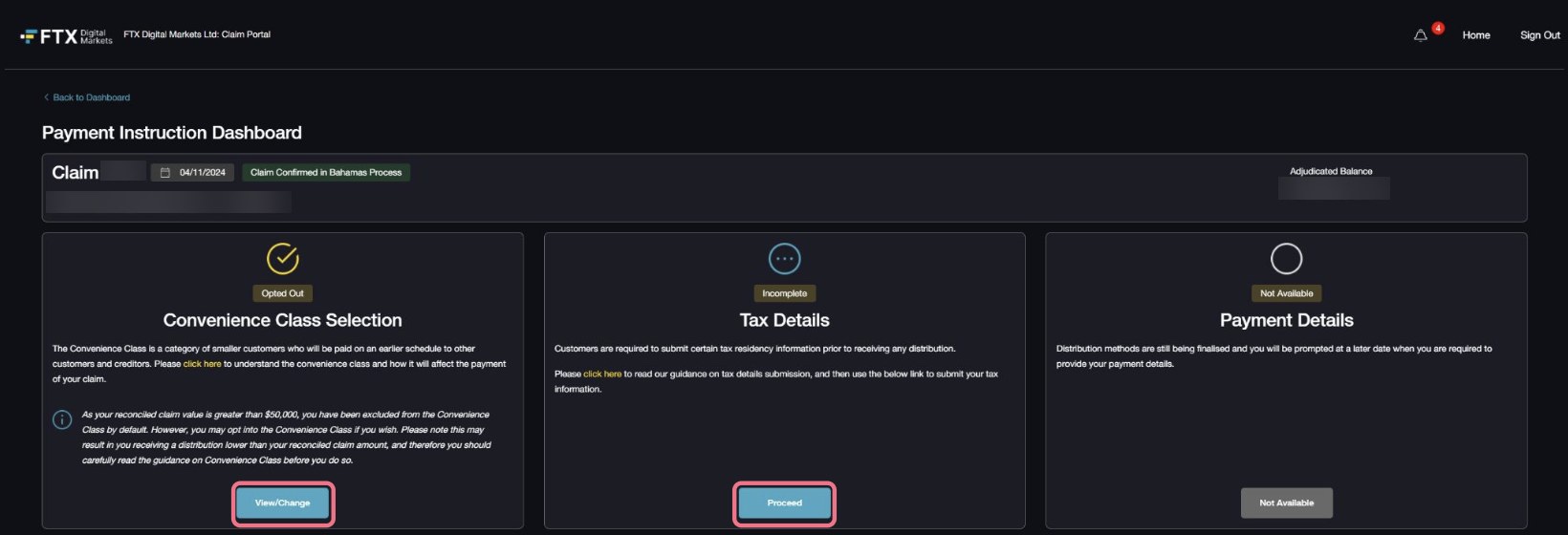
The claim status is shown in your account. For FTX.com and FTX US customers this is the FTX customer claims portal; for customers whose claim is handled in the Bahamas proceeding of FTX Digital Markets, it is the PwC operator's dashboard. If you receive an objection notice, the response period is usually limited and stated in the notice itself. Do not ignore such letters, but check the sender: scammers often send fake notices in the name of FTX and Kroll.
7. Wait or sell your FTX claim
The extension does not take money away from creditors. But for those whose claim is not yet allowed, it means at least one more year of uncertainty. Everyone decides for themselves, and both options have their advantages.
- Wait for distributions. You receive the full amount under the plan, but you take on the risk of an objection, the timelines and possible new extensions.
- Sell your FTX claim. You get money now, and the risk of waiting and of a dispute passes to the buyer. We covered how to sell a claim after partial distributions in "Selling an FTX claim after partial distributions".
If you decide to sell, check the buyer. The steps are described in our guide "How to check an FTX claim buyer in Kroll".
We are following case 22-11068 and will update this article after the November 19, 2026 hearing.
Is your FTX claim under review, disputed or restricted?
Reclaim Capital buys FTX claims from any country starting from $5,000. The review is free with no upfront payment, we reply within 24 hours, and settlement is in USDT, USDC or USD. Deal terms are discussed individually, and a video call is possible before the deal.
Frequently asked questions
What is the FTX claims objection deadline?
How many FTX claims are still under review?
Will the extension delay FTX distributions?
Does the extension affect restricted FTX claims?
Can I sell a disputed or restricted FTX claim?
This article was prepared by the Reclaim Capital research team. We specialize in special situations in complex jurisdictions, the purchase of distressed assets and the protection of creditors' rights.
Please note: this publication is for information and analysis only and is not legal advice. Facts are based on the text of the FTX Recovery Trust motion (case 22-11068 (KBO), docket 36919 of November 5, 2026, published by the claims agent Kroll at cases.ra.kroll.com/FTX). Estimates and assumptions marked in the text as ours reflect the opinion of Reclaim Capital. The court has not yet considered the motion.
Contact us: @ReclaimCapital

