
FTX payouts in Saudi Arabia 2026: why they are frozen and how to sell your FTX claim
Creditors who passed FTX KYC with a Saudi address still cannot collect a riyal: no payout partner covers the Kingdom, and in 2025 the estate even asked the court for a way to forfeit such claims. Here is where Saudi claims stand today, which deadline to watch, and how to sell your FTX claim to Reclaim Capital for USDT, USDC or USD.
 Reply within 24 hoursPaid in USDT · USDC · USDNotice of Transfer filed in court…days
until the 5th-round deadline
Sources: FTX Support restricted list of 30 Oct 2026 (US case), the PwC list for FTX Digital Markets (Bahamas), FTX court filings of July and November 2025, Capital Market Authority statements, GASTAT census data. Not legal advice.
Why FTX creditors in Saudi Arabia have not been paid
Every FTX payment passes through one of three distribution partners, BitGo, Kraken or Payoneer, and each runs its own identity checks before releasing funds. None of them is offered to residents of Saudi Arabia in the FTX Customer Portal. Without a partner, the payout has no route to you.
Saudi Arabia is therefore on the restricted jurisdictions list published by FTX Support on 30 October 2026, which covers 43 jurisdictions in the US bankruptcy. It is also on the list of 46 kept by PwC for the Bahamas liquidation of FTX Digital Markets. We collected the practical questions for this situation in our guide for creditors left without an FTX distribution provider.
The Kingdom has never set up a licensing regime for crypto platforms. In February 2018 the Capital Market Authority warned investors about digital currencies, and in August 2018 a committee chaired by the CMA, with the Saudi Central Bank (SAMA) taking part, stated that virtual currencies are not official currency and that no one is licensed to deal in them. As of 2026 the Kingdom still has no licensing regime for crypto exchanges. Payout firms prefer markets with clear rules, and Saudi Arabia does not yet offer that for crypto.
The test is the residential address on your KYC. Around 44% of the Kingdom’s residents are not Saudi citizens, according to GASTAT’s 2024 estimate, and every one of them with a Saudi address is in the same position as a Saudi national living in Riyadh or Jeddah.
Saudi FTX claims: what the delay can cost you
In July 2025 the FTX Recovery Trust filed a motion for a Restricted Jurisdiction Procedure covering 49 countries, Saudi Arabia among them, under which claims that could not be paid might eventually be forfeited to the trust. The motion was withdrawn on 3 November 2025, but without prejudice: it can be filed again. For Saudi creditors this is the clearest sign that waiting is not risk-free.
Meanwhile the money is moving elsewhere. About $2.2 billion went out on 31 March 2026 and about $900 million on 31 July 2026. A holder of an allowed claim who does not onboard with a provider within six months of a distribution date may lose the right to distributions on that claim, which for the July round means roughly 31 January 2027. Read our notes on the fifth FTX distribution and on the consequences of a missed payout.
A creditor in Saudi Arabia cannot onboard at all. Claims in this position may be switched to Disputed, marked as an ineligible jurisdiction, and the court has not said how it will treat them. How disputed claims are being processed is covered in our article about the longer objection deadline for FTX claims. You can follow your own claim in the Reclaim Capital FTX claim tracker.
Key dates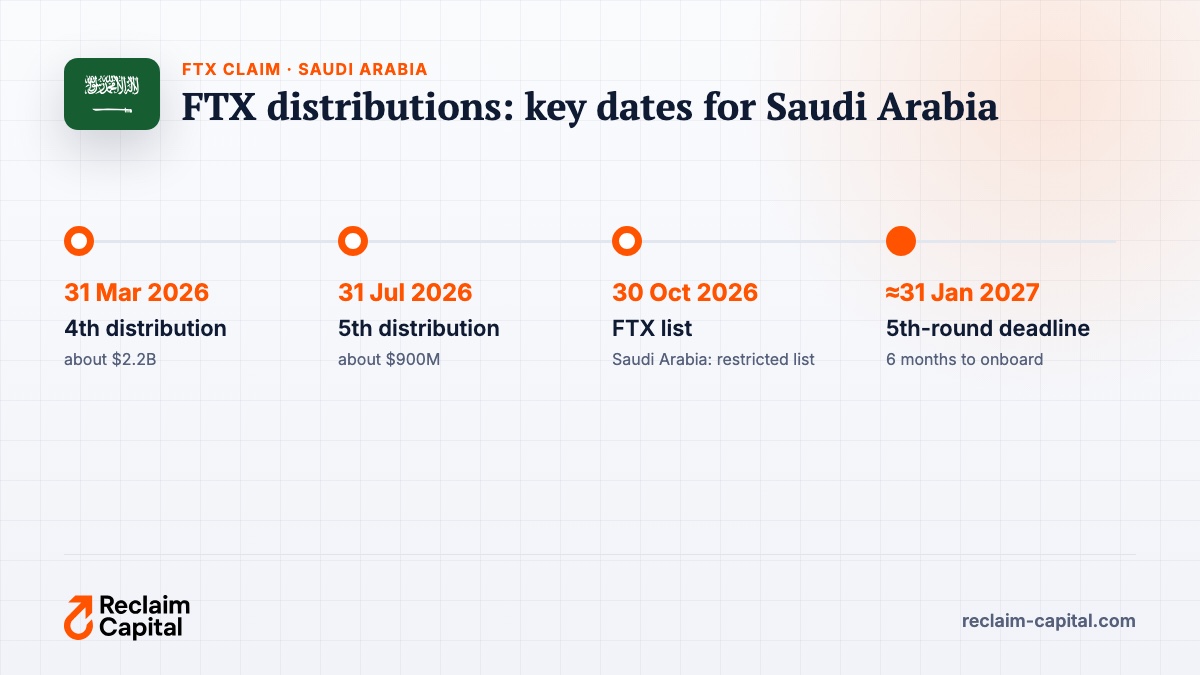
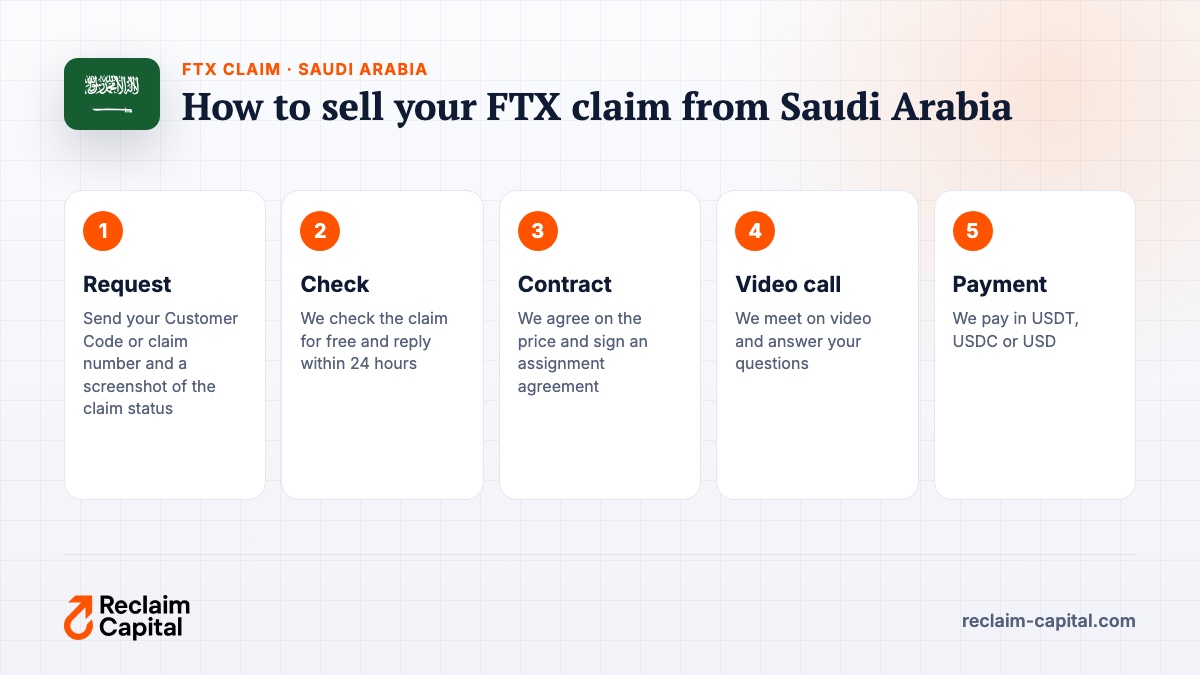
How to sell your FTX claim from Saudi Arabia in 5 steps
- RequestShare your Customer Code or claim number and a screenshot showing the claim status in the FTX portal.
- CheckWe assess the claim free of charge and send you an answer within 24 hours.
- ContractWe agree the price and sign an assignment agreement; your national ID or Iqama, or a passport, confirms your identity.
- Video callYou meet our team on a video call before signing and can ask about every clause.
- PaymentYou receive USDT or USDC to your own wallet, or USD in some cases, on the timeline set in the contract.
Video: how a claim from a restricted country is sold
How the price of a Saudi FTX claim is set
Four things drive the price: the size of the claim, its status (Allowed or Disputed), any distributions already received on it, and how complete your paperwork is. We do not publish a fixed rate. You get a concrete offer after a free review, and turning it down costs you nothing.
Because the riyal is pegged to the dollar at 3.75, a dollar-denominated offer translates directly into SAR. Compare offers from several buyers on the whole package: the payer, the payment date and the contract terms.
How Saudi sellers can verify a claim buyer
Everything below can be checked independently, before you send us a single document.
We do not ask for advance payments, service fees, wallet keys or exchange logins. Ownership of the claim changes through the court: a Notice of Transfer is entered on the FTX bankruptcy docket and validated by Kroll. A checklist for doing your own due diligence is on our verification page.
Be wary of anyone who offers to “rescue” a Saudi claim from forfeiture for an upfront fee or says they act for FTX or Kroll: neither charges creditors for payouts.
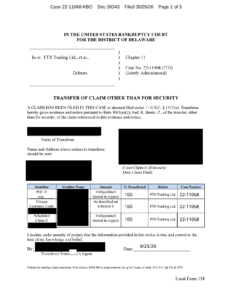 Transfer of ClaimTransferredView a sample (PDF) ↗
Oleh Chubai
Before signing, ask for the full name of the counterparty, its registration details, the price and the payment terms, and check them against the agreement.

Check your case in 30 seconds
What is your claim status in the FTX portal?
FAQ
Can residents of Saudi Arabia receive FTX distributions today?
No. The FTX portal offers no provider for the Kingdom, so the payout is deferred and FTX has not given a date. If a provider becomes available, the list and the portal should change.
Was there a plan to cancel claims from Saudi Arabia?
In July 2025 FTX asked the court for a procedure that could have led to forfeiture of claims in 49 restricted countries, including Saudi Arabia. The motion was withdrawn on 3 November 2025 without prejudice, so it may come back.
I am an expatriate working in Riyadh. Am I affected?
Yes, if the address you verified with FTX is in Saudi Arabia. Eligibility depends on residence, not nationality. Moving the address on paper without actually relocating breaks the rules and can lead to a blocked claim.
Is selling a claim lawful?
Trading claims is an ordinary part of US Chapter 11 cases: the transfer is filed with the court, Kroll checks it, and there is a 21-day window for objections. For questions about Saudi law, speak to a local adviser.
Which documents will I need?
The Customer Code or claim number, a screenshot of the status and an ID document (national ID, Iqama or passport). We send the full list after the first review; see also our guide to the documents for selling an FTX claim.
Is there any fee?
None. The review is free and there is no prepayment or commission.
Get an offer for your Saudi FTX claim
Free review, answer within 24 hours, no obligation
- No fees and no prepayment
- Payment in USDT, USDC or USD
- Each case is reviewed individually

