

- The stake was sold: SWI disclosed its acquisition of the trust’s holding and the related release from litigation. Dismissal of the lawsuit alone does not establish a zero recovery.
- Simple proportions do not work: neither SWI’s aggregate initial acquisition price ($500 million for 38.3% of GDA) nor the July financing repayment ($153 million) can be mechanically allocated to FTX without the purchase agreement.
- The risk of double counting: GDA transaction proceeds may already be included in the trust’s second-quarter report ($359 million from venture investments and $48 million from settlements) and may have contributed to July’s $900 million distribution. SWI’s €800 million October capital raise does not automatically create additional payments to creditors.
- 1. First clue in the FTX and Genesis Digital case: what remained of Alameda’s investment
- 2. The FTX lawsuit against Genesis Digital: linking the sale and dismissal
- 3. SWI Group: why $500 million cannot be attributed to FTX
- 4. Third clue: July’s $153 million
- 5. The FTX stake in Genesis Digital: tracing cash receipts
- 6. What this could mean for FTX creditor payouts
- 7. Who owns the business’s new value?
- 8. Which document would complete the investigation?
1. First clue in the FTX and Genesis Digital case: what remained of Alameda’s investment
The story begins with share purchases between August 2021 and April 2022. The trust later valued the disputed transfers at approximately $1.15 billion and, on 22 September 2025, brought claims against GDA, related companies and two co-founders.
According to the complaint’s transfer table, the co-founders received approximately $550.9 million for their personally held shares. Other payments related to shares purchased from GDA itself. The investment therefore combined funding the company with buying out existing owners’ interests.
The trust alleged that misappropriated funds were used and that the shares were bought at inflated prices. These are the plaintiff’s allegations, not judicial findings in the GDA case. Nor was the claimed amount cash already available: recovery still required litigation or a settlement on other terms.
The trust also retained another potential source of recovery: the shares themselves. Their fate is the key to the June events. We examine how venture investments became part of the bankruptcy estate in “The FTX Paradox”: from Alameda’s portfolio to creditor payouts.
2. The FTX lawsuit against Genesis Digital: linking the sale and dismissal
On 15 June, the trust filed a Voluntary Notice of Dismissal with Prejudice. Court document 31 dismisses all asserted claims against all defendants. The two-page notice contains no settlement amount or payment information.
Read alone, this court document leaves the economic outcome unknown. SWI, however, discloses the other part of the story: as part of its purchase from FTX, the group obtained a release from litigation affecting GDA, its personnel and shareholders, together with signed releases. The same description appears in the acquisition’s financial notes.

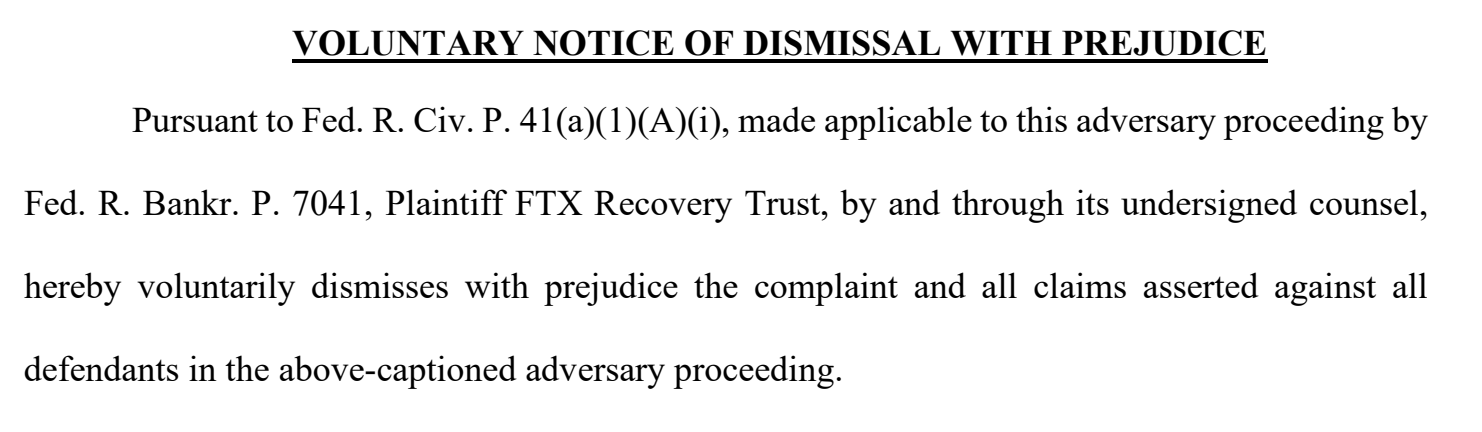
The FTX stake in Genesis Digital and dismissal of the lawsuit: an authentic excerpt of SWI’s disclosure on the 19.7% holding and related releases (slide 1); the court notice, which does not disclose a payment amount (slide 2).
Open SWI’s disclosure on page 57 ↗ · Open the court notice ↗
The connection between sale and settlement is supported by the buyer’s express disclosure, not merely the proximity of the dates. However, the purchase agreement and release documents were not found in the public materials reviewed. It is therefore impossible to separate the consideration for shares from that for settlement, or establish any additional rights and obligations of the parties.
The FTX lawsuit against Genesis Digital ended with a voluntary dismissal of the asserted claims with prejudice. This is neither a ruling vindicating the defendants nor proof that the trust received nothing.
3. SWI Group: why $500 million cannot be attributed to FTX
SWI announced an initial acquisition of approximately 38.3% of GDA for aggregate consideration of $500 million. Its full report explains the structure: the acquisition closed on 12 June and consisted of two transactions — buying a holding company with an interest in GDA and purchasing shares directly from an existing shareholder.
The $500 million relates to the aggregate acquisition, not a separately disclosed payment to FTX. The report does not allocate the price between sellers. Pricing the trust’s stake by applying the ratio of 19.7% to 38.3% is also unjustified: that calculation assumes equal rights and prices for all shares and ignores the settlement terms.
A further complication is the liquidation preference: the initial holding carried approximately 77.2% of its aggregate $1.124 billion value. These are preferential rights attached to particular share classes upon events specified in their terms. The figure is not a voting percentage, transaction price or guaranteed cash payout.
SWI obtained control of GDA later. Further acquisitions took place between the June purchase and control, including a 4.4% stake from Stone Ridge funds. The financial notes date the acquisition of control to 6 August: approximately 70% of voting rights and about 62% economic ownership. These measures are not interchangeable and cannot all be attributed to the initial $500 million.
4. Third clue: July’s $153 million
Another detail appears in subsequent events: in July, SWI repaid approximately $153 million of vendor financing for the GDA acquisition.
This changes the analysis: even if the shares transferred to SWI in June, the sellers need not have received the entire cash payment at that time. Yet the document does not identify the recipient of July’s payment. It cannot be attributed to FTX or added to $500 million as a proven additional purchase price.
Looking only at June receipts is therefore insufficient. We first need to establish whether the trust participated in that financing and when it was paid. This remains an open question, not a confirmed deferred payment to FTX.
5. The FTX stake in Genesis Digital: tracing cash receipts
FTX’s second-quarter report moves from the buyer’s valuation to the seller’s actual cash receipts: during the quarter, the trust received $359 million from venture investment sales and $48 million from donation recoveries and settlements.
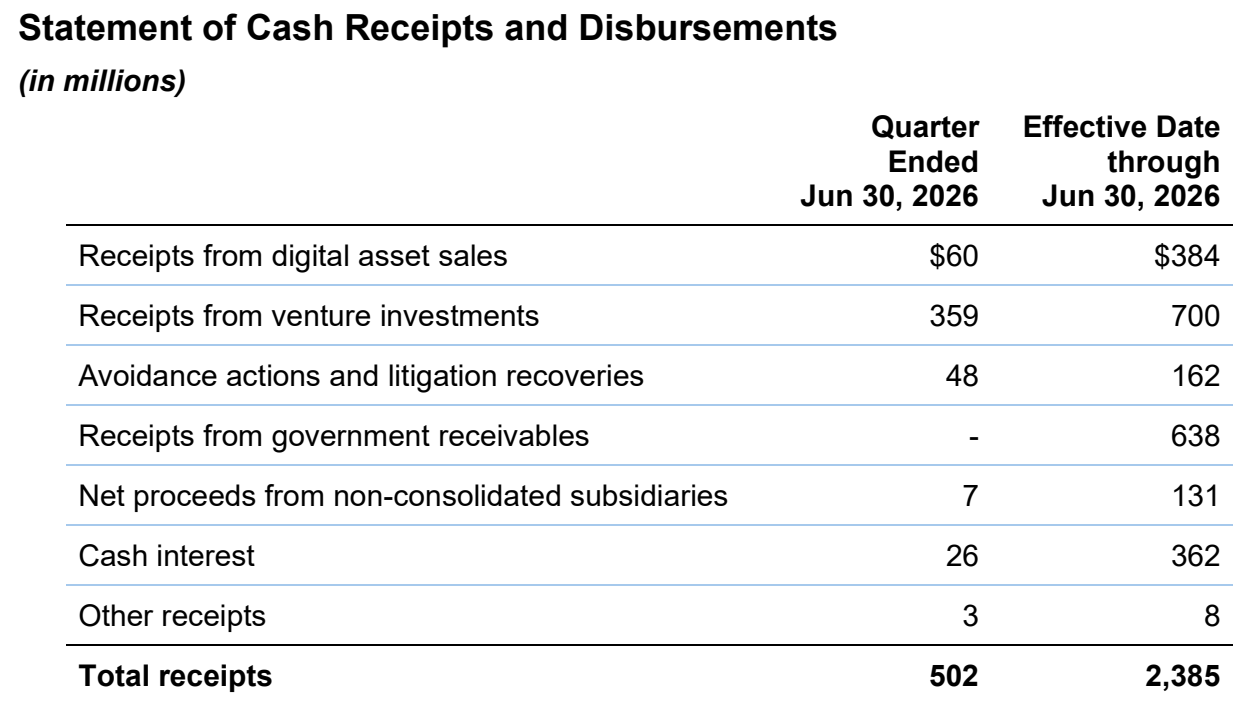
FTX’s second-quarter cash receipts: the table on page 6; amounts in millions of dollars. Quarterly receipts: 359 from venture investments; 48 from avoidance actions and litigation recoveries. There is no separate GDA line.
Open the table’s page ↗
The amounts are aggregated; the document contains no separate GDA entry. The sale may have been included, but the report cannot isolate either the share price or payment for ending the dispute. The report is also unaudited: it is the trust’s own operational disclosure, not an independent verification of every transaction.
Two scenarios are possible. If FTX was paid in June, part of the proceeds may already have entered the trust’s overall second-quarter liquidity. If payment was deferred, a July receipt could appear in third-quarter reporting; a separate GDA disclosure there is also not guaranteed. The available documents do not establish which scenario occurred or the amount under either one.
6. What this could mean for FTX creditor payouts
Proceeds from the trust’s asset sales can finance distributions under the plan. But the price of a stake does not translate directly into a payment to a particular creditor: operating and legal costs, reserves, distribution priorities and the rights of the relevant claim class intervene.
The status of each claim matters too. A separate analysis examines Know Your Customer (KYC) and Source of Funds (SOF) checks in the FTX process.
The trust reports that it completed a distribution of approximately $900 million on 31 July. By that date, allowed and estimated allowed claims accruing interest had been covered through distributions or reserves at no less than 100%, and further interest accrual ceased. This does not mean every creditor personally received payment, nor does it disclose GDA’s contribution to the distribution.
In announcing its fifth distribution, FTX reported cumulative payouts of 105% for customer classes 5A and 5B, 103% for classes 6A and 6B, and 120% for Convenience Claims. These percentages are measured against the allowed claim amount; they do not mean the original cryptocurrency quantity was returned at today’s prices.
Further receipts remain relevant after the 100% threshold. The report describes the Supplemental Remission Fund mechanism after satisfaction of the specified senior claims. Any additional payment follows the plan’s rules and does not automatically arise at the same percentage for everyone.
The main analytical risk is double counting: if sale proceeds already contributed to the trust’s liquidity, they cannot be presented again as a new future source of payouts. Without an itemised breakdown, no separate “Genesis bonus”, amount or date can be promised.
7. Who owns the business’s new value?
The October capital raise concerns SWI Group itself. The company announced new ordinary shares issued to institutional investors at a resulting valuation of €6.1 billion. For those funds to become an FTX receipt, a separate legal connection is required — for example, a retained ownership interest or contractual additional consideration. No such connection has been established in the documents reviewed.
Separately, SWI recognised approximately €647.2 million in gains on its initial acquisition of the GDA interest, valued at approximately €1.093 billion. The valuation relied on forecasts, including the use of infrastructure for artificial intelligence computing.

SWI Group’s acquisition gain: the authentic paragraph on page 57 discloses €647.2 million of gain on acquisition of an associate under IAS 28.32. This is the buyer’s accounting result, not a transfer to the trust.
Open the financial note ↗
The amount may raise questions for creditors, but its nature matters: it is the buyer’s accounting gain on acquisition of an associate under IAS 28.32. It does not show how much cash the trust received or, by itself, prove that the asset was sold too cheaply. Selling the stake while ending the dispute may have allowed the trust to monetise its investment and remove uncertainty over further litigation. Whether that choice benefited creditors cannot be established without the transaction terms, alternative offers and an assessment of litigation prospects.
If the trust transferred its entire economic interest and retained no additional rights, future growth in the business’s value belongs to its new owners. Without the agreement, however, the complete absence of retained rights — such as an earn-out — cannot be treated as proven either.
8. Which document would complete the investigation?
The main open questions are FTX’s separate consideration, the payment procedure and timing, allocation between shares and settlement, and any retained rights. Answers could come from the purchase agreement, settlement documents or a trust report itemising GDA cash receipts. The next quarterly report will help only if the data are not again combined into a single aggregate line.
SWI’s disclosure establishes the sale of the disclosed stake and associated releases; the court notice confirms dismissal of the asserted claims. The reviewed materials do not yet establish the amount received by the trust or its contribution to creditor payouts.
This distinction matters to creditors: dismissal does not prove the asset’s value vanished, while an increase in SWI’s valuation does not automatically confer rights to its new funds. FTX’s economic outcome depends on payments under the June deal and any retained contractual rights.
Is your FTX claim still awaiting payment or held up by verification?
Reclaim Capital specialises in purchasing distressed claims in Chapter 11 proceedings and supporting complex FTX creditor cases. Discuss your claim’s status and possible sale terms with the Reclaim Capital team.
Questions creditors still have
Did FTX actually sell its Genesis Digital stake?
Can $500 million be treated as a recovery for the trust?
Why can’t FTX’s price be calculated from the stake percentage?
Has the $1.15 billion lawsuit been dismissed with finality?
Does this mean the court rejected FTX’s allegations?
Could the trust have received payment after June?
Who received July’s $153 million?
Could GDA proceeds already have funded distributions?
Does SWI’s €800 million capital raise mean extra payments to FTX creditors?
What does SWI’s approximately €647.2 million gain mean?
Social media sometimes links the GDA deal to FTT. Is there a connection?
What should creditors monitor next?
This material was prepared by Reclaim Capital’s analytical team. The memorandum is based on documents checked on 13 October 2026. Statements by parties, allegations and conditional scenarios are distinguished; individual payout rights are not determined here.
Contact us: @ReclaimCapital

