
Bitget restricted your account: preparing a reply to the AML review
We read your Bitget notice against the Terms of Use dated 4 November 2026 and help you assemble the KYC/AML documents and timeline support asks for. Only Bitget decides on your account.
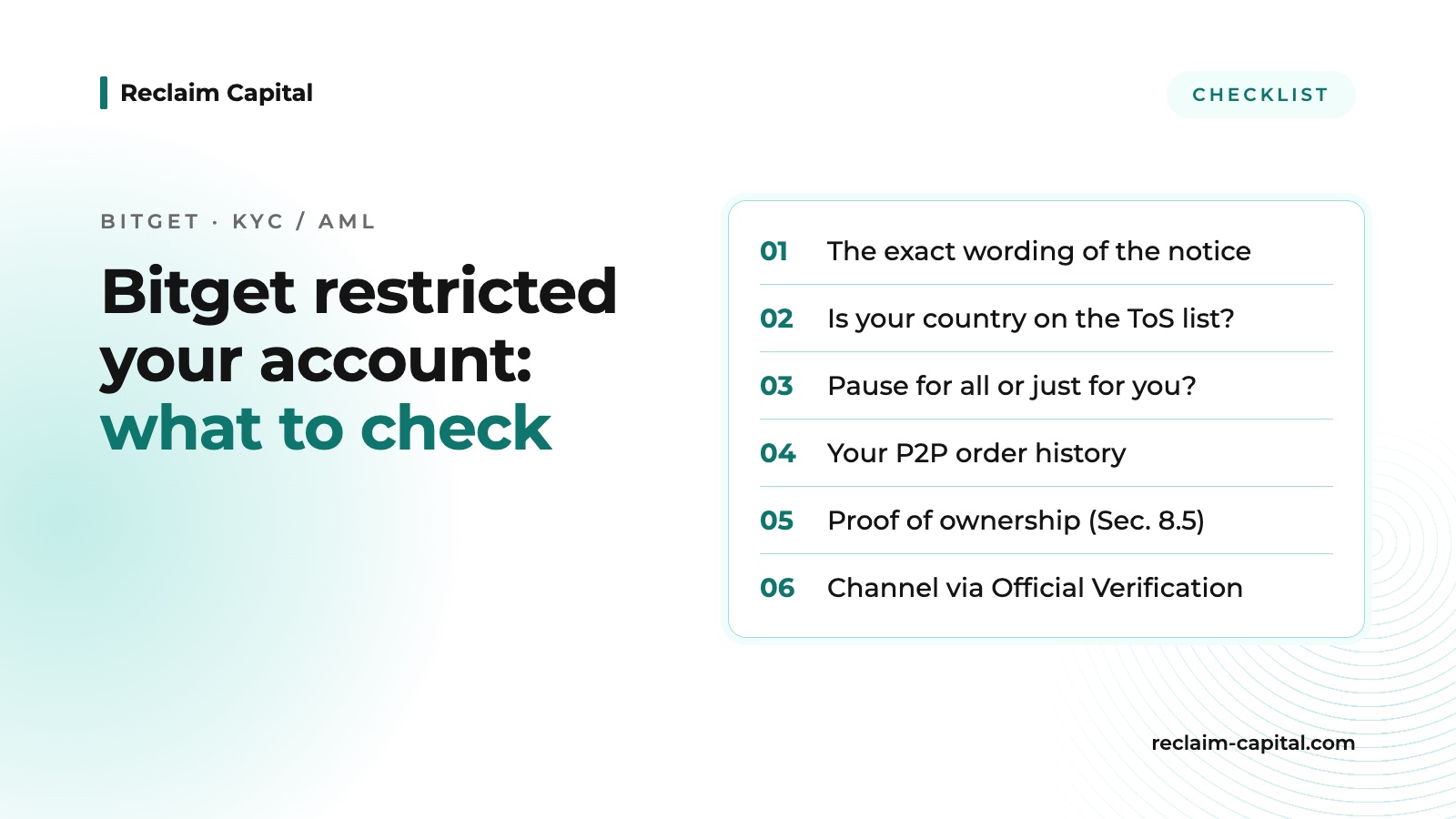 Bitget ToS, 4 Nov 2026Withdrawal-only modeProof of ownership
Sources: Bitget Terms of Use (updated 4 Nov 2026); Bitget Academy guide “Resolving Account Restrictions” (2024); Bitget help pages on official verification and P2P rules; reporting by Cointelegraph, crypto.news and ForkLog, 2023–2026.
Why Bitget freezes accounts and withdrawals: AML and sanctions
Bitget’s Terms of Use (the contracting entity is BTG Technology Holdings Limited) give the exchange broad powers. Under Section 8.2, Bitget may suspend or close an account, block withdrawals and even force-close positions, immediately and without prior notice. A brief “account restricted” message is therefore routine.
Bitget Academy’s guide to account restrictions lists the usual triggers:
- signs of account compromise, such as a SIM swap or stolen password;
- contact with scammers in P2P trades or fiat deposits;
- links to sanctioned persons or regions, or travel to sanctioned countries;
- Terms of Use breaches, including forged documents;
- missing KYC/AML documents;
- funds traced to hacks, fraud or DeFi incidents;
- law enforcement requests.
The ToS also bans holding more than one account per person (Sections 5.3 and 8.2) and buying or selling verified identities (Section 11.1). In serious cases, Bitget says, it may not disclose the reason at all.
In 2023 Bitget CEO Gracy Chen said (per ForkLog) that restrictions apply to users from any country when an AML breach is suspected. General playbook: what to do when an exchange blocks your account.
Bitget and your country: Russia, Belarus, Kazakhstan, Japan, Thailand
Section 1 of Bitget’s ToS contains a list of Prohibited Countries. The 4 November 2026 version includes Russia, Belarus, Kazakhstan, the United States, Canada, France, Germany, Austria, Singapore, Japan, Thailand and the UAE, plus Crimea and several other regions of Ukraine.
In October 2026, according to crypto.news, Bitget began winding down service for some users in Russia, Belarus and Kazakhstan, with deadlines set account by account. Bitget did not disclose how many users were affected or the regulatory basis. Go by the date in your own email.
For Japan, Cointelegraph reports phased restrictions starting 1 November 2026, with forced position closures planned for 31 December 2026. In Thailand, the local SEC is seeking to block Bitget’s website and app from 5 December 2026.
Honestly: if your country is on the list, Bitget may close the account, and the goal is usually withdrawing the balance. Bitget’s guide says sanctions cases are typically moved to withdrawal-only mode with advance notice. Section 8.6 forbids bypassing location rules with a VPN, and even travel to a prohibited country can trigger a block. We do not help change profile countries or hide your location.
Which deadlines Bitget publishes and which it doesn’t
Bitget does not state how long a compliance review or unfreeze takes; its restrictions guide contains no figures. Nor is there a published withdrawal window after closure, beyond individual dates sent when Bitget exits a market.
A few concrete numbers do exist. Bitget’s P2P rules say that for non-instant payments the seller must release the crypto within two business days. Sections 18.2–18.3 of the ToS set out the dispute route: written notice to legal@bitget.com, a 30-day window before arbitration, and a one-year limit for filing a claim.
Platform-wide pauses are different. In late September 2026, after a hot wallet hack, Bitget halted withdrawals for everyone and reopened them coin by coin; Section 7.5 of the ToS allows such pauses.
What Bitget may request and how to build your response
The baseline is identity verification (KYC): an ID document plus a face check. Bitget has required it from all users since 2023; under the rules of that time, unverified accounts could only withdraw, cancel orders and close positions. The next level adds proof of address.
When lifting restrictions, Bitget’s guide only mentions “additional information or verification documents”. There is no published source-of-funds checklist, so the reply must match the actual request:
- where deposits came from: statements, trade history from other platforms, transaction hashes with an explanation of the origin;
- P2P episodes: bank transfer receipts, the order chat, counterparty details;
- ownership: under Section 8.5, Bitget holds funds until it receives “acceptable” proof that they are yours.
If an incoming stablecoin transfer is involved, also check the address, see USDT wallet unlock. If the restriction followed a takeover of your account, start with crypto hack recovery.
How we prepare a response to a Bitget restriction
- NoticeWe read the Bitget notice word for word and match it to a cause in Bitget’s guide.
- RulesWe check your case against the current ToS, Sections 1, 7.5, 8.2, 8.5 and 8.6, to see what Bitget can actually require.
- TimelineWe reconstruct the flow of funds: deposits, P2P orders, withdrawals, logins from new devices or other countries.
- FileWe assemble documents for Bitget’s specific request and write a short, consistent explanation.
- Follow-upsWe help with further questions from support and tell you when it is time to bring in a lawyer.
Mistakes that drag out a Bitget review
- Several tickets at once via chat and email with differing accounts of events; the reviewer sees contradictions.
- Answering a different question: Bitget asked about a specific P2P order and you sent your passport again.
- Screenshots without source data: no hashes, dates or amounts means nothing can be matched.
- Logging in via VPN during the review: Section 8.6 prohibits bypassing location rules, and it can make things worse.
- A “temporary” second account: a direct breach of the one-account rule.
- Trying to close the account: under Section 5.17 you cannot close it while a freeze or hold is in place.
When a Bitget case needs a lawyer, not just emails
A good reply resolves many routine reviews. Some situations call for an attorney:
- a large balance held under Section 8.5 with no movement after all replies;
- police or court involvement or seized funds; Bitget’s guide says law enforcement contacts the user directly in such cases;
- sanctions questions, or an account closed with the balance withheld;
- a ToS dispute: Hong Kong law, HKIAC arbitration, notice to legal@bitget.com.
We do not replace a lawyer in court, but can hand counsel an organised case file. Every case gets an individual approach because situations differ a lot; scope and terms are discussed once we have reviewed yours. Other exchanges are covered in our exchange account unblock hub, for example Bybit.
How to tell us apart from fake “Bitget support”
Bitget channels are verified on Bitget itself; we can be checked through public records.
When it sent account-closure notices in October 2026, Bitget itself warned users about phishing and impersonation. Check any link, email or social media account through Bitget’s official verification page, and look for the anti-phishing code in emails. We never ask for your seed phrase, passwords, 2FA codes, account access or remote access to your computer, and we never message first on Telegram on behalf of an exchange. The only official channel for your account is Bitget support; here is how to verify us.
Due diligence checklist →Oleh Chubai
Before any work starts, ask for the full company name and a contract describing the tasks, then check the details against the state register.

FAQ
Bitget won’t explain why my account is restricted. Is that allowed?
Under Section 8.2 of the ToS, Bitget can restrict an account without prior notice, and its guide says that in serious cases the reason may not be disclosed.
I live in Russia. Can I still withdraw from Bitget?
Russia is on the prohibited list in the 4 November 2026 ToS. In October 2026 Bitget sent some users individual deadlines to close positions and withdraw. Follow the date in your own email; the realistic aim is usually withdrawing the balance, not continuing to trade.
What does a hold “until proof of ownership” mean?
That is Section 8.5 of the ToS: if Bitget suspects unlawful possession, it holds the funds and the account until it receives acceptable proof that they belong to you. In practice: where the funds came from, with documents.
Withdrawals stopped for everyone. Is my account blocked?
Not necessarily. In late September 2026, after a hack, Bitget paused withdrawals for all users and reopened them in stages. Section 7.5 of the ToS permits such pauses; check Bitget’s announcements first.
My P2P counterparty won’t release the coins. How long should I wait?
Bitget’s P2P rules say that for non-instant payments the seller must release the crypto within two business days. If that doesn’t happen, open an appeal on the order and attach the transfer receipt and chat history.
Can I just close the account and take the balance?
Not while a freeze, hold or restriction is active; Section 5.17 of the ToS rules that out. The restriction has to be lifted, or Bitget has to switch you to withdrawal mode, first.
Can you speed up Bitget’s decision?
No. We are an independent company with no special access to Bitget. The decision and its timing are Bitget’s.
Unblocking on other exchanges
Further reading
- Exchange blocked your account: 7 steps to an appeal
- Binance and OKX reject MEXC transfers: the FinCEN order
- Binance hack of 29 October 2026: what clients should do
- Recovering funds after a hack or scam
- Trust Wallet hacked: what to do
- USDT wallet unlock
- Unlocking and verifying a USDC wallet
- How to verify Reclaim Capital
Tell us about your Bitget restriction
Send the text of the Bitget notice, without passwords or codes, and we will tell you where to start.
- Notice reviewed against Bitget’s ToS
- Timeline of deposits and P2P orders
- Documents matched to Bitget’s request

