
Trust Wallet hacked: what you can still do after the theft
Trust Wallet keeps the keys on your device, not on its servers, so it can’t block a transfer or an account. We work out what happened to your wallet and check whether the funds ended up somewhere they can be frozen.
 Extension v2.68: who was hitRevoke approvals, new phraseIf the funds hit an exchange
Sources: Trust Wallet community update on the v2.68 browser extension incident (published Dec 30, 2025, updated Jul 17, 2026); Trust Wallet support articles on wallet scams and fake apps; Binance FAQ on reporting stolen funds transferred to Binance; reports on Tether USDT freezes; FBI IC3 PSA230811.
Why Trust Wallet can’t undo the theft
Trust Wallet is a self-custody wallet. Your private keys and recovery phrase live on your device; the company holds no copy, keeps no account for you on a server and has no button that stops a transfer.
That has two uncomfortable consequences. First, Trust Wallet support cannot lock the wallet your coins went to, and cannot reverse a transaction on the network. That is not company policy, it is how blockchains work. Second, anyone who has your phrase controls the funds just as fully as you do, from any device.
So the recovery question doesn’t start with Trust Wallet. It starts with where the coins went after they left your address. If they reached an exchange or are sitting in USDT, there is a third party that can hold them. If not, we will tell you plainly that funds taken from a self-custody wallet without such a point usually cannot be recovered.
How to tell which way your Trust Wallet was drained
What to do next depends on how the theft happened. The transaction history on a block explorer usually shows which pattern applies.
- Every coin sent out within minutes, with no signature from you: the attacker has your phrase or key. This follows typing the phrase into a phishing site, a fake app or a compromised extension.
- Tokens pulled by someone else’s contract via transferFrom: at some point you signed an approval or a Permit on a drainer site. Your phrase may be safe, but the permission is still live.
- One transfer to a familiar-looking address that differs from the right one in the middle characters: address poisoning, where you copied a planted address from your history.
- A loss on the Chrome extension in late December 2025: this may be the v2.68 incident described below.
If this is hard to read on your own, send us the wallet address and a couple of TxIDs. From public data we can identify the mechanism and explain what it means for you. The wider picture on wallet thefts is on our crypto hack recovery page.
The Trust Wallet v2.68 extension incident and compensation
According to Trust Wallet’s official update, on December 24, 2025 a malicious build of the Chrome extension, v2.68, was published outside the standard release process. Affected users are those who logged into v2.68 between December 24 and 26, 2025, up to 11:00 UTC on December 26. The company says the mobile app and other extension versions were not affected; the fixed build shipped as v2.69.
Trust Wallet counted 2,520 affected addresses and about 8.5 million dollars linked to 17 attacker addresses. It said it would voluntarily reimburse affected users. Claims are accepted only through the official Trust Wallet support form. By the time of the update it had received more than 5,000, many of them duplicates or fraudulent. Each is reviewed individually, timing varies, and the company gives no overall deadline.
What matters if you are claiming: file once, yourself, keep the TxIDs of the outgoing transfers and state that you used v2.68 during that window. Third-party compensation agents who offer to speed up payment or ask for your phrase to verify ownership have nothing to do with Trust Wallet.
If funds stolen from Trust Wallet reached an exchange or USDT
At this point the wallet no longer matters. The route of the coins does. We follow it from your address to the first point that has the power to block funds.
Funds on an exchange
If the chain ends at an exchange deposit address, the receiving account passed KYC and can be locked. But as Binance states in its FAQ on stolen funds transferred to Binance, it won’t freeze assets without an official order from police or a court, and getting that order is up to the victim. For a report, Binance asks for a list of TxIDs with explorer links and a copy of the police report.
Funds in USDT or USDC
If the thief swapped into a stablecoin, the issuer can technically blacklist the address. Based on public reports, Tether does this at the request of law enforcement, while Circle generally requires a court order. More on our USDT and USDC pages.
Either way the path is the same: a police report where you live, then a request from the agency to the exchange or issuer. We prepare a timeline and transfer map that an investigator can pass on without rework.
What you can realistically do after a Trust Wallet hack
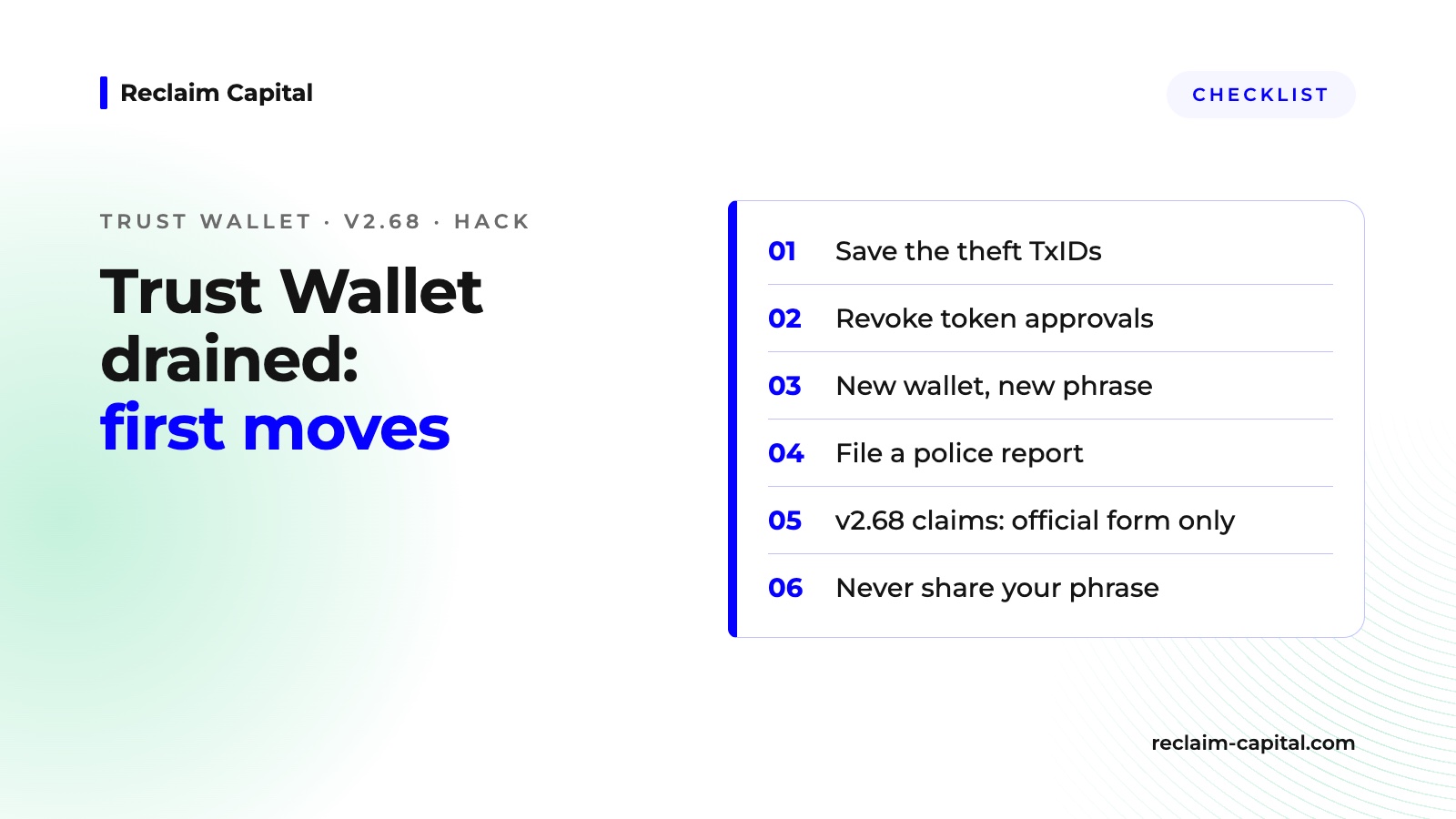
- TxIDsOpen the history in Trust Wallet or a block explorer and save the hashes of all outgoing transactions, receiving addresses, amounts and times.
- ApprovalsIf a contract did the stealing, revoke the approvals with a third-party approval checker for that network, or it will take new deposits too.
- New walletCreate a new wallet with a new recovery phrase on a clean device and move what’s left. Stop using the old phrase.
- Police reportFile a report with the police; in the US, also with IC3. Attach the TxIDs and mention it if you used extension v2.68.
- Freeze pointCheck with us whether the funds reached an exchange or USDT. Scope and terms are agreed after the review, as cases vary widely.
Fake Trust Wallet support and counterfeit apps
Victims post about the theft on social media and in chats, and may quickly hear from fake Trust Wallet support. In its incident update the company warns clearly: Trust Wallet will never ask for your private keys, seed phrase or passwords, and you should only use official channels.
- A message asking you to enter your 12 words to sync your wallet is always theft, even if the link looks like trustwallet.
- Fake apps appear in ads and third-party stores; Trust Wallet has published its own guide to spotting them. Install the wallet only from the official app store.
- A recovery specialist who contacts you first and asks for an upfront fee is the classic scheme from FBI warning IC3 PSA230811.
We are no exception to the rule: check us too. Our details and how to confirm you are talking to us are on How to verify Reclaim Capital.
We are not Trust Wallet or its partners
We are an independent firm with no access to the wallet or its support team.
After the v2.68 incident Trust Wallet warned users about impersonators: victims may be approached by fake Trust Wallet reps and compensation agents. Real compensation goes only through the official support form, with no middlemen and no recovery phrase. We work from public addresses and TxIDs.
Due diligence checklist →Oleh Chubai
Before any work starts, ask for the full company name and a contract describing the tasks, then check the details against the state register.

FAQ
Can Trust Wallet support block the thief’s wallet?
No. Trust Wallet is self-custody and controls neither your address nor anyone else’s. Only an exchange or a stablecoin issuer can block funds, at the request of authorities.
I use the Trust Wallet mobile app. Does the v2.68 incident affect me?
According to Trust Wallet, the mobile app was not affected. The incident concerns only Chrome extension v2.68 and log-ins between December 24 and 26, 2025.
How do I claim compensation for v2.68?
Only through the official Trust Wallet support form, once, and by yourself. Each claim is reviewed separately and the company gives no general timeline.
My phrase is safe, but tokens were taken. How?
Most likely you signed an approval on a drainer site earlier. Revoke it and move the remaining funds to a new wallet.
Is changing the app password enough after a hack?
No. The password only protects the app on your device. If the phrase leaked, only a new wallet with a new phrase helps.
The stolen coins went to an exchange. What now?
File a police report and keep the TxIDs. Exchanges such as Binance freeze assets on an official request from an agency, not on a victim’s email.
Is there any chance if the funds just sit in the thief’s wallet?
If they are ordinary coins in a self-custody wallet with no exchange or issuer along the way, recovery is usually not possible. We’ll say so plainly after the review.
If the funds went to an exchange
Further reading
Send your Trust Wallet address and theft TxIDs
From public data we’ll identify how the wallet was drained and whether an exchange or USDT issuer sits on the route.
- We use the address and TxIDs, no phrase
- We’ll check whether v2.68 is involved
- We’ll prepare a timeline for police

