
Crypto stolen? Find out where the funds can still be stopped
A confirmed blockchain transfer can’t be reversed. But if the stolen funds reach a stablecoin issuer or an exchange, law enforcement can request a freeze. We help you find that point and build the file.
 USDT and USDC freezesExchange deposits: TxIDsDrainers, address poisoning
Sources: Binance FAQ How to Report Stolen Funds Transferred to Binance; Bybit Help Center on reporting stolen assets; reports on Tether and T3 Financial Crime Unit freezes; Chainalysis (Dec 2025) and ScamSniffer (Jan 2026) reports; FBI IC3 PSA230811 and PSA250813; Trust Wallet v2.68 incident update.
Why a stolen crypto transfer can’t simply be recalled
A bank wire passes through an operator who can halt it. An Ethereum, TRON or Bitcoin transaction does not: once a block confirms it, no wallet app, developer or outside firm like ours can undo it.
A real chance only exists where the stolen coins land with someone who has the power to block them. In practice there are two such points: the stablecoin issuer (Tether for USDT, Circle for USDC) and a centralized exchange that the thief uses to swap or cash out. Both act on requests from police or courts, not on emails from victims.
So our job is not to recover the money ourselves. It is to work out quickly whether your case has a freeze point, and to put together material the police can use to send a request. If the coins went to another self-custody wallet, through a bridge or a mixer, and never stopped anywhere, recovery is usually not possible, and we will tell you so.
Scenario 1. Stolen USDT or USDC: a freeze at the issuer
Stablecoins differ from ETH or BTC in one useful way: the token contract lets the issuer blacklist a specific address. The balance stays there, but it can no longer be moved.
Tether (USDT)
According to published reports, Tether blocks addresses at the request of law enforcement and courts, and also on its own initiative, for example addresses on the OFAC sanctions list. There is no direct channel for an individual victim. The route runs through a police report, after which the agency submits the request. There is also the T3 Financial Crime Unit, a joint effort by Tether, TRON and TRM Labs; The Block reports that in urgent cases such as account takeovers and violent crime it has executed freezes within 24 hours of a request from authorities.
Circle (USDC)
Based on public summaries, Circle’s blacklisting policy relies on a court order or a regulator’s demand. ICIJ reported that some US prosecutors said Circle declined to freeze funds without one. For USDC, that means preparing for a court step, not just a police report.
To see how address blocks work in more detail, read our pages on USDT wallets and USDC wallets. We help pin down the address where your stablecoins sit right now and present it so an investigator knows exactly what to ask for and from whom.
What to do in the first hours after the theft
Thieves tend to push funds through bridges and chains of fresh addresses as fast as they can. The sooner the path is recorded, the better the odds of catching the coins at an address that can still be blocked.
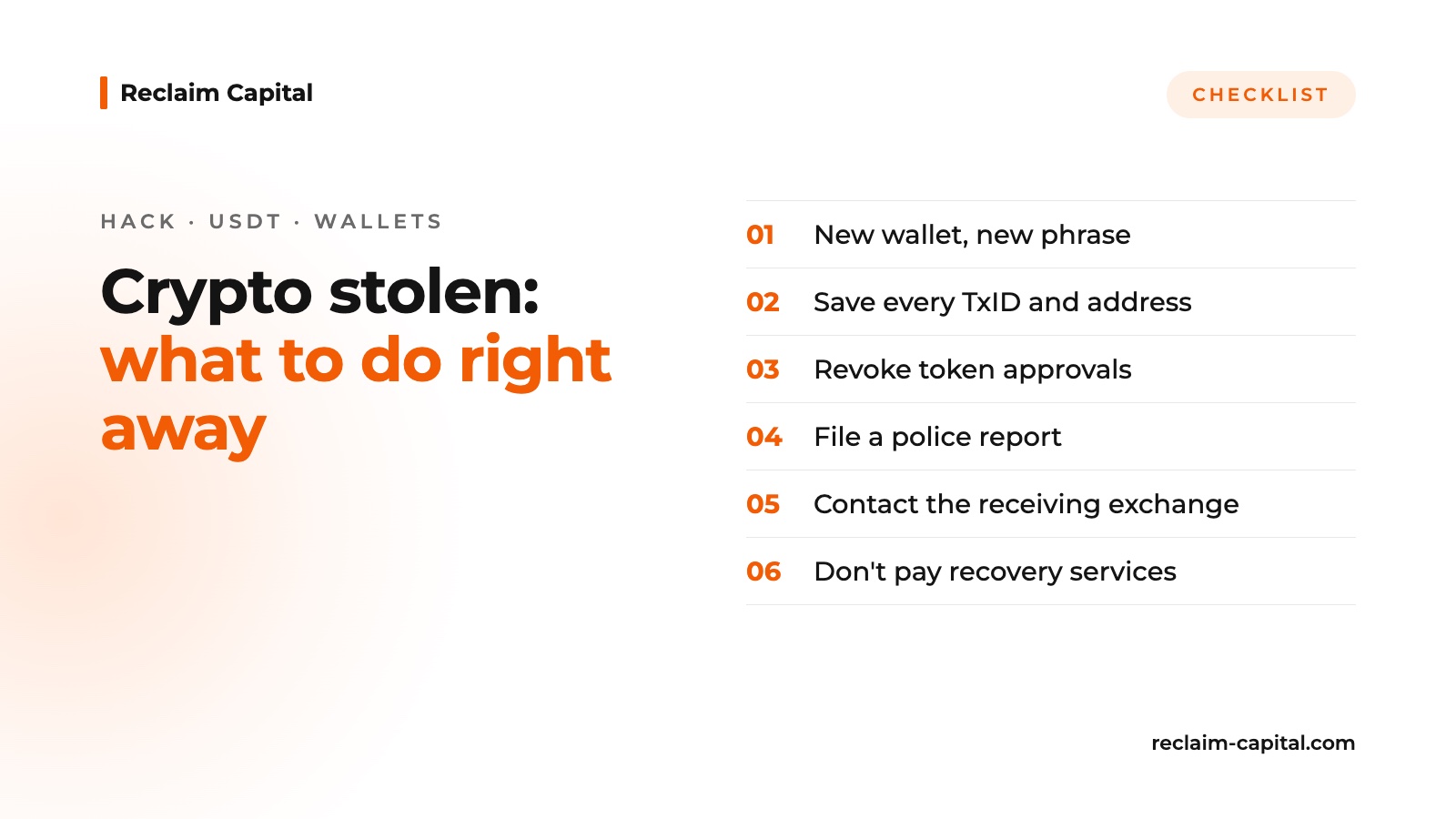
- Cut off access. If the wallet is compromised, move whatever is left to a new wallet with a new recovery phrase, set up on a clean device.
- Save every TxID. Copy the hashes of all outgoing transactions, the receiving addresses, times and amounts, and take block explorer screenshots.
- Keep the evidence. Save chats, the link to the site where you signed, and the name of the app or extension you used.
- File a report. With your local police; in the US, also submit a complaint to IC3. Exchanges will ask for the report number.
- Contact the receiving exchange through its official support if the trail leads to a centralized platform.
Scenario 2. Funds moved to an exchange: the police route
When the transaction trail hits a deposit address at Binance, Bybit, OKX or another major platform, the theft suddenly has a recipient: an account that passed KYC. The exchange can lock it, but as a rule only on an official request.
Binance’s FAQ How to Report Stolen Funds Transferred to Binance states that it cannot unilaterally freeze a user’s assets without an appropriate official freezing order from law enforcement or a court, and that obtaining it is up to the victim, via local police. Binance asks for a description, transaction details, a list of TxIDs with explorer links and a copy of the police report. Agencies file their requests through the Kodex portal.
Bybit’s Help Center has a section on reporting stolen assets. Based on its description, Bybit accepts a case only if the funds actually arrived on Bybit, and getting a freeze order remains the job of the victim and the police. OKX, based on public information, takes freeze requests from law enforcement via Kodex; we did not find a separate page for victims.
We follow the coins on-chain to the deposit address, identify which exchange serves it, and build the police file: a timeline, a transaction table and an explanation of the flow. If your case involves a platform we cover, see our page on Binance or the exchange section.
How we work through a crypto theft case
- TimelineYou send TxIDs, addresses and a short account: when you noticed, what you signed, who you talked to. No wallet access is needed.
- TracingWe follow the transfers from your address through bridges, swaps, USDT addresses or exchange deposits.
- Freeze pointWe give an honest view of whether an issuer or exchange could technically hold the funds, and how long that window may stay open.
- Police fileWe prepare the timeline, transaction table and flow chart so an investigator can send a request to Tether, Circle or the exchange.
- Follow-upWe help with follow-up questions from the exchange or agency. Scope and terms are agreed after the review, as every case is different.
Scenario 3. A hacked wallet: drainers, fake apps, poisoned addresses
Chainalysis counted around 158,000 personal wallet compromises in 2025, with losses of 713 million dollars. Most cases follow one of four patterns.
- Drainer. A phishing site asks you to connect your wallet and sign an approval or a Permit. After that, the attacker’s contract pulls the tokens on its own. ScamSniffer put 2025 losses to such sites on EVM chains at 83.85 million dollars.
- Leaked recovery phrase. It was typed into a website, a fake support form or a bot. Official wallets, Trust Wallet included, never ask for your Secret Recovery Phrase, and scammers fake the screens for creating and restoring a wallet.
- Fake app or extension. Counterfeit builds of Trust Wallet and other wallets show up in ads and third-party stores. A separate story is the compromised official Trust Wallet extension v2.68 in December 2025, covered on our Trust Wallet hack page.
- Address poisoning. A lookalike address, matching your usual one in its first and last characters, is planted in your history in the hope that you copy it from there.
In all four cases the wallet is self-custody, so there is no account for anyone to lock. What matters is where the funds went next: into USDT, onto an exchange, or nowhere reachable. If any token approvals are still live, revoke them, or a drainer can take whatever arrives later.
How to tell us apart from recovery scammers
After a theft, victims get targeted a second time. In PSA230811 the FBI describes the pattern: so-called crypto recovery companies reach out on social media and messengers or buy search ads, take an upfront fee, then vanish or send an incomplete tracing report and ask for more. They may claim ties to law enforcement. The FBI stresses that private companies cannot issue seizure orders, and that law enforcement does not charge victims.
In the updated PSA250813, IC3 warns about fake law firms that promise to recover funds through legal channels, move victims into WhatsApp groups and demand bank fees in crypto or gift cards. Red flags, per the FBI: no licence, refusing a video call, and knowing your past amounts and dates. IC3 data for 2025 shows 10,516 recovery scam complaints and about 1.4 billion dollars in losses.
What this means for how we work:
- we don’t promise to get funds back and don’t quote success rates;
- we never ask for a recovery phrase, private keys, passwords, 2FA codes or remote access to your computer;
- we don’t contact you first or pose as staff of an exchange, Tether, Trust Wallet or the police;
- we don’t freeze anything ourselves; issuers and exchanges do that at the request of authorities.
Our company details and ways to check them are on How to verify Reclaim Capital.
Why you should question us, too
After a theft, check anyone who offers help, including us.
If a specialist found you after the theft, knows the amount and promises to get the coins back for a fee, that is the scheme the FBI and the UK FCA describe. The FBI stresses that law enforcement does not charge victims and that private firms cannot issue seizure orders. Check our details before any conversation.
Due diligence checklist →Oleh Chubai
Before any work starts, ask for the full company name and a contract describing the tasks, then check the details against the state register.

FAQ
Can crypto be recovered once the transaction is confirmed?
The transaction itself can’t be reversed. Funds can only be stopped if they sit at an address a stablecoin issuer can block, or on an exchange that receives an official request.
Will Tether freeze my stolen USDT if I email them directly?
Based on public information, Tether acts on requests from law enforcement and courts. As an individual, start with a police report; the agency then sends the request.
The exchange can see the stolen coins arrived. Why won’t it lock them?
Binance’s own FAQ says it cannot freeze a user’s assets without an official order from police or a court. Your message can flag the case, but the legal basis comes from the agency.
The funds were bridged to another chain. Is that the end?
Not always. The trail can sometimes be picked up on the other chain’s explorer. But if the coins then settle in self-custody wallets, there may be no freeze point, and we will say so at once.
Should I revoke approvals after a drainer attack?
Yes. If you signed an approval or a Permit, the attacker’s contract may still pull tokens later. Revoke them and move what’s left to a new wallet with a new phrase.
Do you need access to my wallet to check the balance?
No, never. Public addresses and TxIDs are enough. Anyone asking for your recovery phrase or private key is acting like a scammer.
A lawyer who already knows my loss amount has contacted me. Is that you?
We never reach out first. The FBI names knowledge of your amounts and dates as a sign of a fake law firm. Use only the contacts listed on our website.
If the funds went to an exchange
Further reading
Tell us about the theft and we’ll check where the coins are
Send the TxIDs and the address the funds left from, and we’ll assess whether an issuer or exchange could hold them.
- Only public addresses and TxIDs needed
- We never ask for your recovery phrase
- We’ll say so if there is no freeze point

