
1. Timeline: from a Brazilian investigation to a lawsuit
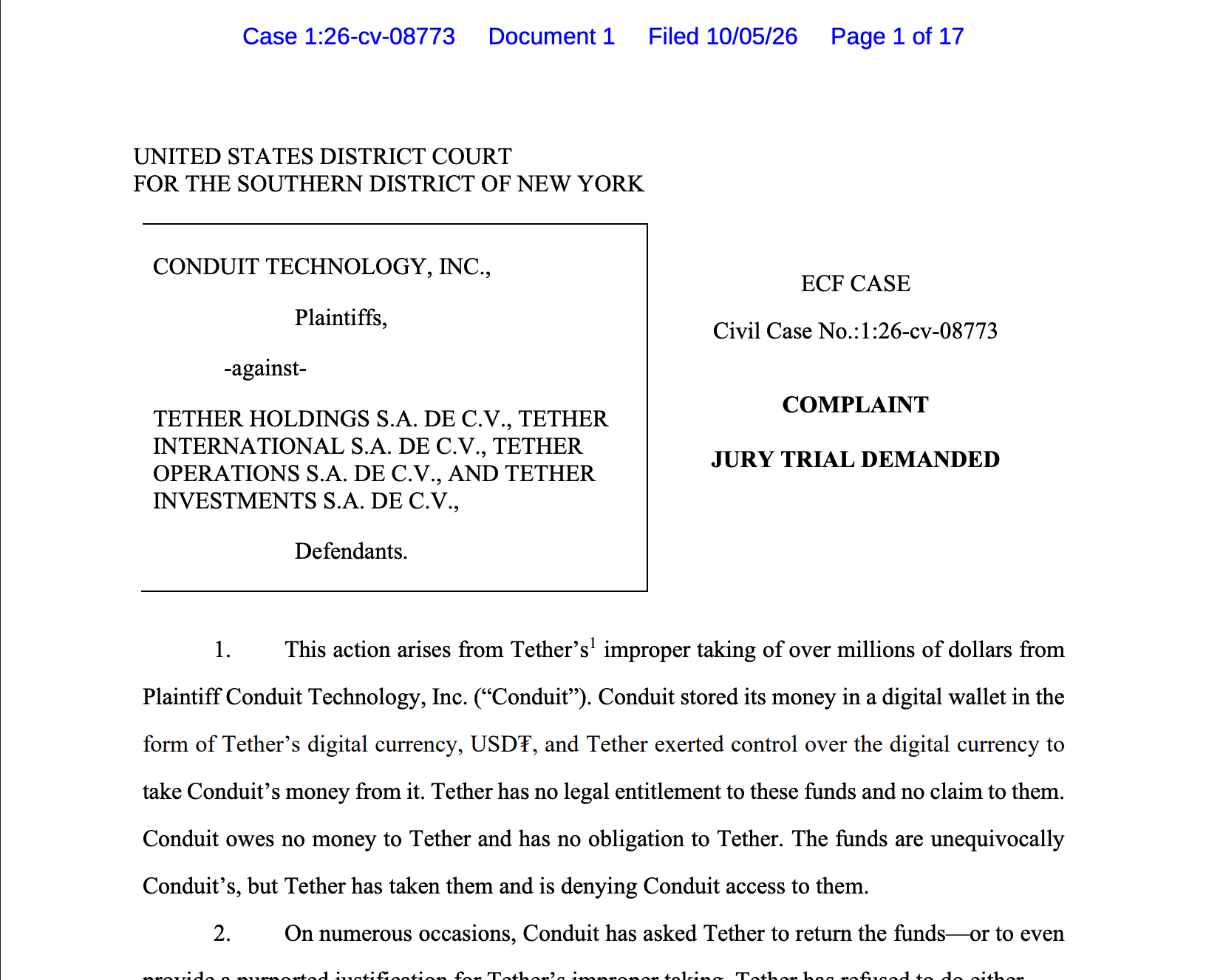
For a payments company, a USDT wallet is not an investment but an operating account: client payments are pre-funded and settled from it. In the lawsuit, Conduit calls the frozen wallet “the digital equivalent of the company’s operating bank account.” The wallet sat with the institutional custodian Fireblocks, and only Conduit treasury staff could sign transactions. Losing access, the company says, cut its volumes and forced it to lay off staff and close offices. It is a textbook example of how a blocked USDT wallet can paralyze a company that has nothing to do with any wrongdoing.
2. We checked the blockchain: what a USDT freeze looks like
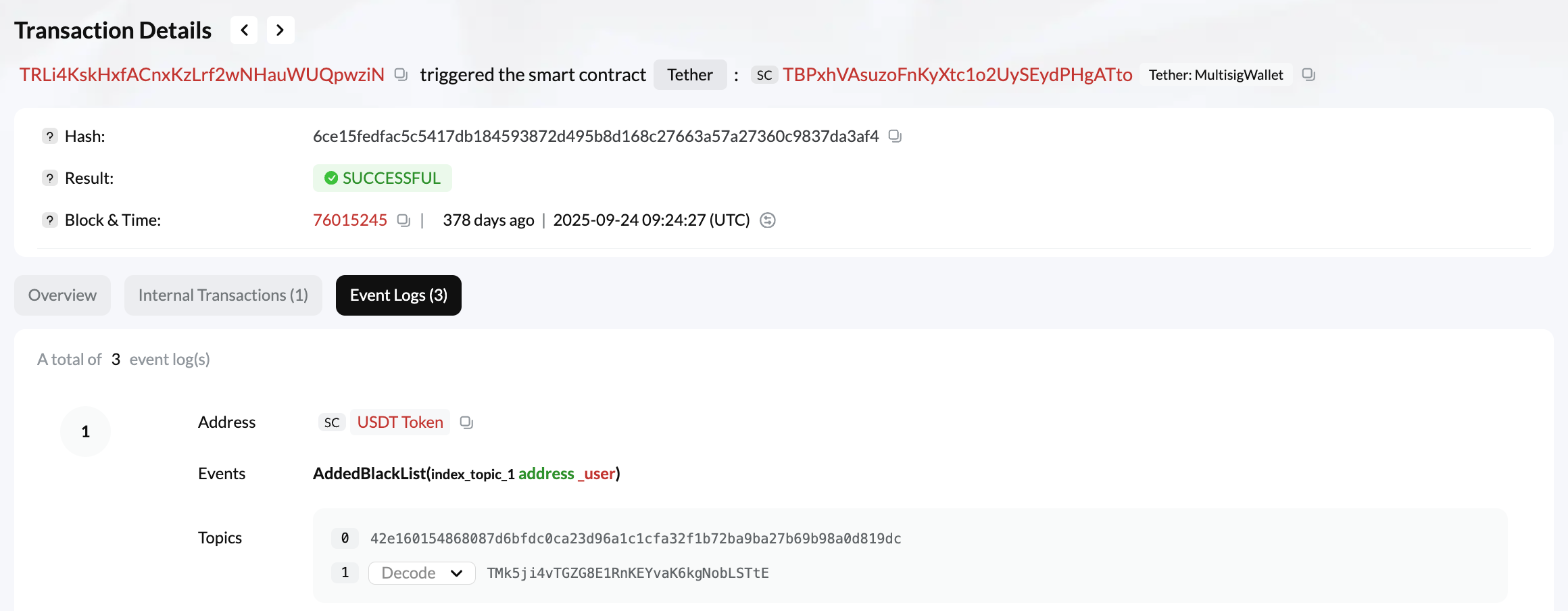
A footnote in the lawsuit gives the address of the frozen wallet. We checked it against public Tron network data: the USDT smart contract contains a record of Tether adding this address to the blacklist, and it matches the date in the lawsuit.
TMk5ji4vTGZG8E1RnKEYvaK6kgNobLSTtEWhat the data shows. Conduit’s wallet was not blocked on its own but in a batch: between 09:22:57 and 09:24:33 UTC, Tether blacklisted 23 addresses in a row, one in almost every block. A batch like this looks like a list of addresses from a single case being processed. The funds at the address have not been destroyed or reissued: the balance is still about $2.76 million. Data as of October 7, 2026.
How a USDT freeze works technically
In the USDT smart contract on Tron and Ethereum, the issuer has three functions: add an address to the blacklist, remove it, and destroy the funds at the address (destroyBlackFunds). A freeze does not burn the tokens: the balance stays where it is, but it cannot be moved. Tether’s terms of service reserve the company’s right to freeze any user’s tokens. A freeze takes seconds, while unfreezing can take months, and there is no single procedure for it. We covered this path in detail in our guide “USDT Wallet Unblocking in 2026”.
3. The Brazilian trail: who chose the wallet to freeze
The most important part of the lawsuit is its explanation of where the freeze came from. According to Conduit, the Brazilian Federal Police, as part of the Bull and Onix case, identified suspicious wallets from cloud data and passed their addresses to Tether. Conduit’s wallet was not on that list. The police later confirmed this and said they did not know what criteria Tether used to choose the addresses to freeze. The Brazilian criminal court, for its part, acknowledged that Conduit is not a subject of the investigation and that no order was issued to freeze its assets.
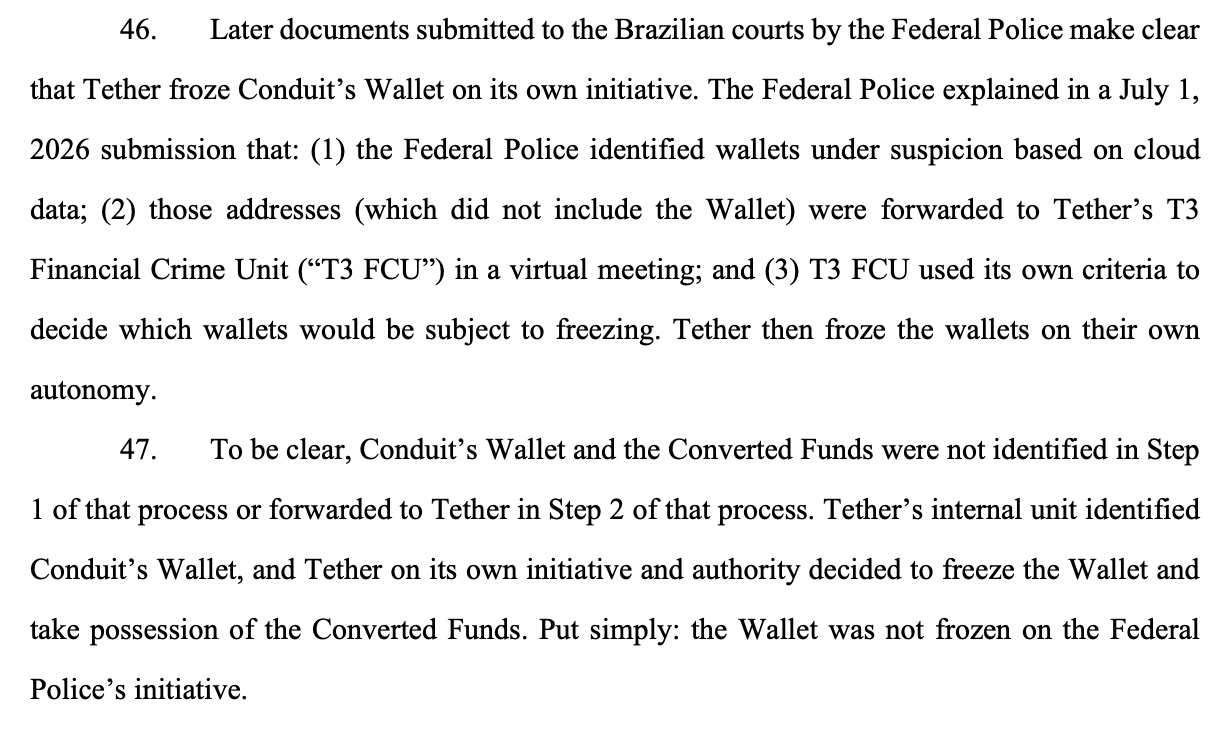
“Put simply: the Wallet was not frozen on the Federal Police’s initiative.”
From the complaint in Conduit Technology, Inc. v. Tether Holdings, ¶ 47The compliance logic is clear: Onix was once a Conduit client, and an automated risk assessment could have linked the company’s addresses to the parties in the case. But the frozen wallet was created almost a month after Onix’s last transaction, and, according to the lawsuit, none of the 4,427 transactions through it involved Onix.
If Conduit’s account is confirmed, it would mean Tether froze the company’s funds based on its own risk assessment, without any request from authorities concerning Conduit itself. That logic could catch any business that once accepted a payment from a counterparty with a bad history.
The risk is often visible in advance: an address’s risk score rises because of “tainted” incoming transfers. That is why a regular AML wallet check of your own addresses and your counterparties is not a formality but cheap insurance.
Important: this is one side’s account. Tether has not yet presented its version in court, and the case has not been heard on the merits.
4. What Conduit wants from Tether
The lawsuit is based on six claims: conversion, unjust enrichment, breach of fiduciary duty, computer fraud under federal law (18 U.S.C. § 1030), declaratory judgment and accounting. Conduit asks the court to:
- Declare that Tether has no right to freeze the wallet and no rights to these USDT.
- Order the unfreezing of the wallet and restore access.
- Award at least $2,760,000 in direct damages plus consequential damages.
- Return the income: interest and profits earned on the reserves backing the frozen tokens.
- Award punitive damages and legal costs.
“Tether has no right to take companies’ money simply because they chose to hold it in Tether’s currency.”
From the complaint in Conduit Technology, Inc. v. Tether Holdings, ¶ 11Why the claim to the income matters more than the amount
Every USDT is backed by reserves, mostly short-term U.S. Treasury bills, and the interest on them goes to the issuer. While the tokens are frozen, the owner cannot use them, but the reserves keep generating income. Across billions of frozen USDT, these are significant sums. Conduit is the first to put the question so directly: who owns this income for the duration of the freeze?
5. The USDT freeze goes mainstream: 2025–2026 figures
Open statistics and on-chain data, as well as reports by analytics firms, in particular the freeze tracker from BlockSec, show that Tether is freezing more and more funds, and doing so daily, mostly on the Tron network.
Source: on-chain data, BlockSec USDT Freeze Tracker. For comparison, according to AMLBot, in 2023–2025 Tether froze $3.29 billion across 7,268 addresses, while Circle (USDC) froze $109 million across 372 addresses.
These figures lead to three conclusions:
- Growth. More was frozen in the first half of 2026 than in the whole record year of 2025. In the 30 days to May 8, 2026 alone, 370 addresses holding more than $514 million were blacklisted.
- Unfreezing is rare. In 2025, only about 3.6% of addresses were removed from the blacklist, with a median of about 18 days from freeze to removal. You need to act fast: about 55.6% of the frozen value is later destroyed and reissued, usually at the request of authorities.
- It is not only “dirty” addresses that get hit. The Conduit case is no longer the only one in which the legality of a freeze is being challenged in court.
Here is what the latest high-profile disputes over frozen USDT look like:
| Case | Amount | What the dispute is about |
|---|---|---|
| Conduit v. Tether lawsuit, October 5, 2026 | $2.76 million | A freeze based on Tether’s own criteria, with no request from authorities against the company itself. |
| Thai entrepreneurs v. Tether lawsuit, August 31, 2026 | $42.4 million | According to the plaintiffs, a freeze in October 2025 at the informal request of a U.S. government agent, several months before a seizure warrant. |
| Creditors of Iran in terrorism cases motion, May 2026 | 344 million USDT | Judgment creditors are asking the court to order Tether to reissue the frozen USDT in their favor. |
| A Brazilian court May 2026 | $213 million | A freeze of 48 wallets by court order in a tax dispute. An example of a freeze with a judicial basis. |
Tether attributes the growth in freezes to fighting fraud, sanctions evasion schemes and money laundering, and a large share of freezes really do involve such cases. But the wider the net, the more often good-faith holders get caught in it: recipients of payments from counterparties with a bad history, P2P platform users, companies whose address turned out to be one or two transactions away from a “flagged” one. If a freeze is linked to a law enforcement request, the steps are different: see our breakdown of LEA requests and unblocking.
6. USDT freeze: what a wallet owner should do
A USDT freeze can hit any business. The Conduit case shows that even for a company with lawyers and investors, unfreezing can drag on for more than a year if it does not build its position from the start. Here are the steps:
- Check the address status. Find out on which network and since what date the address has been blacklisted. You can do this with our free USDT wallet check.
- Identify the source of the freeze. A request from authorities, OFAC sanctions and Tether’s own risk assessment each call for different actions.
- Gather proof of the origin of funds. Contracts, invoices, statements and transaction history, assembled into a document package known as Source of Funds.
- Prepare a legal position. An appeal to the issuer backed by a legal opinion is treated differently from a support ticket.
- Do not delay. The longer the funds stay frozen, the higher the risk that they will be destroyed and reissued at the request of authorities, and then the matter is decided within criminal or forfeiture proceedings.
ANALYTICS DEPARTMENT RECOMMENDATION
Court is a last resort: it is slow and expensive, and the outcome of the Conduit case is still unknown. In many cases it is faster to start by approaching the issuer with a complete document package. If it is USDC rather than USDT that is frozen, the logic is similar but the issuer is different: see USDC unblocking.
The specialists at Reclaim Capital help holders of frozen stablecoins:
Free address status check and analysis of the likely cause of the freeze based on on-chain data.
Preparation of a Source of Funds package, a legal opinion and an appeal to the issuer.
Support for companies whose operating or treasury wallet has been frozen. Terms are discussed individually.
7. What comes next
The case is only beginning: Tether has yet to respond to the lawsuit. Most likely, the company will point to its terms of service and its anti-money laundering obligations. The outcome matters for the whole market: the court may, for the first time, rule on whether a stablecoin issuer may hold funds indefinitely without a court order and without a request from authorities concerning a specific holder, and who owns the income on the reserves during that time.
We are following Case No. 1:26-cv-08773 and will update this article as events develop.
Is your USDT frozen?
We will check the address status and the likely cause of the freeze. The check is free; terms for further work are discussed individually.
Frequently Asked Questions
Why did Tether freeze Conduit’s wallet?
Can Tether freeze USDT without a court order?
How can I find out if my USDT wallet is frozen?
Can USDT be unfrozen?
What happens to frozen USDT if you do nothing?
How much USDT is frozen right now?
This material was prepared by the analytical department of Reclaim Capital. We specialize in managing special situations in complex jurisdictions, buying distressed debt (Distressed Assets), and protecting creditor rights.
Please note: this publication is of an informational and analytical nature and does not constitute legal advice. The facts of the case are taken from the complaint in Conduit Technology, Inc. v. Tether Holdings S.A. de C.V. et al. (S.D.N.Y., No. 1:26-cv-08773) and reflect the plaintiff’s position; the court has not ruled on the merits. On-chain data was checked against public Tron network data as of October 7, 2026. Freeze statistics are based on open data from BlockSec and AMLBot.
Contact us: @ReclaimCapital

