
Living in Fiji with frozen FTX money: how to sell your FTX claim
FTX has no payout partner for people living in Fiji, so allowed claims of island residents are on hold with no date. At the same time, the Reserve Bank of Fiji treats buying crypto with funds held in Fiji as illegal. This page explains where that leaves a Fijian creditor and how a claim can be sold to Reclaim Capital for USDT, USDC or USD.
 Reply within 24 hoursPaid in USDT · USDC · USDNotice of Transfer filed in court…days
until the 5th-round deadline
Based on the FTX Support restricted list of 30 Oct 2026, the PwC list for FTX Digital Markets (Bahamas) and Reserve Bank of Fiji Press Release No. 08/2024. Not legal advice.
Why FTX sends nothing to creditors in Fiji
Money from the FTX estate does not leave the debtors directly. It travels through one of three appointed distribution partners — BitGo, Kraken or Payoneer — and each of them runs its own identity check. If none of the three will onboard customers from a country, that country ends up on the restricted list.
Fiji sits on both versions of that list: the 43-jurisdiction list kept by FTX Support and Kroll in the US case (dated 30 October 2026) and the 46-jurisdiction list of the Bahamas liquidators at PwC. What counts is the home address you confirmed in KYC. A Fijian passport holder living in Australia is treated differently from a foreigner living in Suva.
FTX gives no country-by-country reasons. The local rulebook, though, is unusually strict. In Press Release No. 08/2024 of 15 April 2024 the Reserve Bank of Fiji said that Bitcoin, Ethereum and Tether are not legal tender, that buying or investing in crypto with funds held in Fiji is illegal, and that a resident who invests abroad needs prior RBF approval. Breaches can be penalised under the RBF Act 1983 and the Exchange Control Act 1950.
The same release says the RBF has not licensed anyone to offer crypto investment or trade virtual assets in Fiji. For a payout partner, that means no local licence regime to lean on and a strict exchange control framework around every inbound transfer — reason enough, in practice, to stay away.
FTX has said restricted-country distributions are postponed rather than cancelled and that partners may be added later. No timetable exists. We have collected the questions a creditor in this position should ask in our guide on countries with no FTX distribution provider.
What waiting means for a Fijian FTX creditor
While Fiji has no partner, nothing reaches your claim — even though creditors elsewhere have already received several rounds. The fourth round on 31 March 2026 paid out about $2.2 billion, and the fifth, on 31 July 2026, about $900 million. FTX rules say an allowed-claim holder who fails to onboard within six months of a distribution may forfeit the right to distributions on that claim; counted from the fifth one, the cut-off falls around 31 January 2027. See our notes on the fifth FTX payout round and on what happens after a missed FTX distribution.
Another risk is the claim status itself. A restricted-country claim can be moved to Disputed with a remark that the jurisdiction is ineligible, and the court has not yet ruled on how such claims will be treated. The window for objections has been pushed back, as we describe in our article on the extended FTX objection deadline. You can follow your own status in our FTX claim tracker.
Many Fijian households are used to cross-border money: personal remittances passed $1 billion in the year to September 2025, and more than half of them (52.1%) came in through mobile wallets such as M-PAiSA and MyCash. A claim sale is different: one documented transaction under a contract, and inbound transfers are subject to the RBF Exchange Control Guidelines in force since 1 January 2026. Ask your bank or a local adviser how a payment in USD or stablecoins should be received and reported.
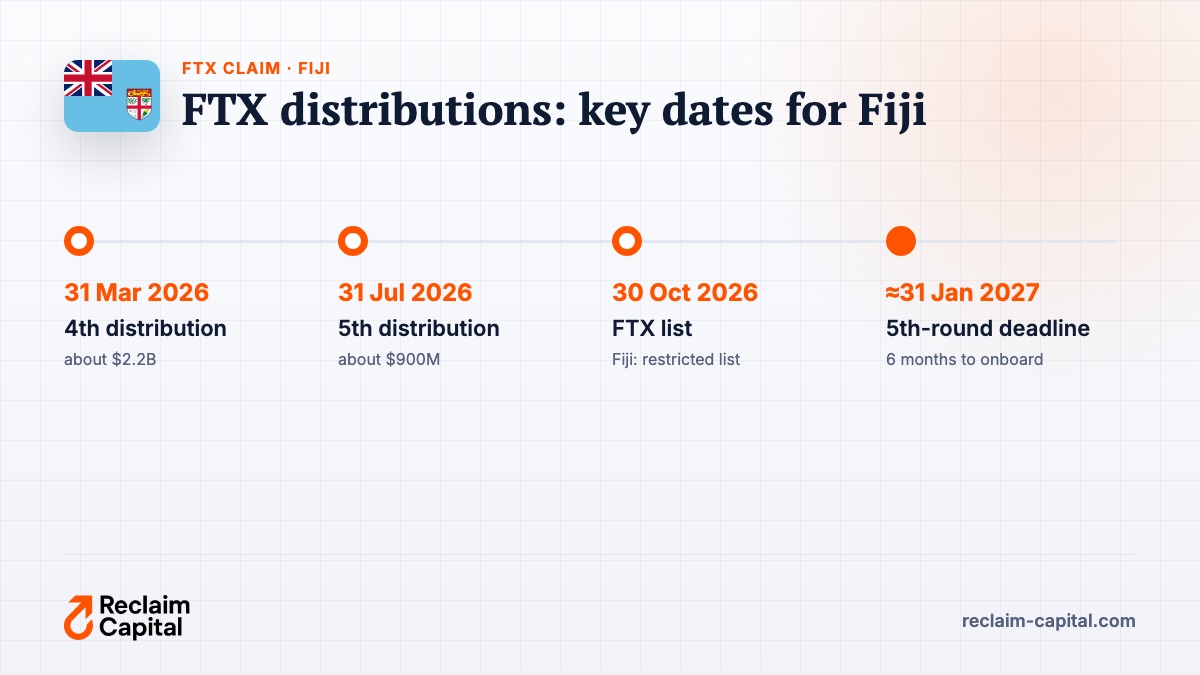
Selling an FTX claim from Fiji in 5 steps
- RequestSend us your FTX Customer Code or claim number and tell us you live in Fiji. We answer within 24 hours.
- CheckWe look at the claim on the Kroll portal: amount, status, rounds already paid. Nothing is charged for this review.
- ContractYou receive an assignment agreement to read at your own pace, with a Fijian passport or other government photo ID used to verify you.
- Video callA short call with our team, so you see who you are dealing with and can ask anything before signing.
- PaymentWe pay in USDT, USDC or, in some cases, USD; a Notice of Transfer then goes on the court docket and Kroll validates it.
Video: how to sell an FTX claim from a restricted-list country
What a buyer may pay for a claim held in Fiji
We do not publish a fixed rate. The offer is built from four things: the claim amount, whether it is Allowed or Disputed, how much has already been distributed on it, and how complete your paperwork is. A clean, allowed claim with a portal screenshot usually moves faster than a disputed one.
Living in Fiji does not by itself lower the price, but the uncertainty around restricted jurisdictions is part of what a buyer takes on. You get a concrete figure only after we have seen the claim — not a percentage quoted in advance. Over 274 deals we have bought claims worth $63.3 million.
Checking a claim buyer from Fiji
Everything below can be checked independently, before you send us a single document.
The RBF has warned specifically about crypto schemes pushed on social media in Fiji, and FTX creditors are an obvious target. A real buyer never asks for a seed phrase, private keys, an upfront fee or a “release payment”. If someone does, stop there.
Due diligence checklist →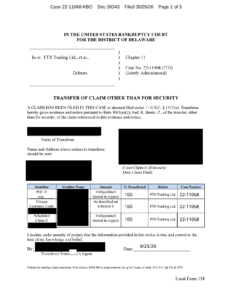 Transfer of ClaimTransferredView a sample (PDF) ↗
Oleh Chubai
Before signing, ask for the full name of the counterparty, its registration details, the price and the payment terms, and check them against the agreement.

Check your case in 30 seconds
What is your claim status in the FTX portal?
FAQ
Is it legal for a Fiji resident to sell an FTX claim?
Selling a bankruptcy claim is a standard assignment under US Chapter 11 and is recorded by the court. How the payment is received in Fiji is a separate question under the Exchange Control Act, so check with a local adviser or your bank first.
Does the Reserve Bank of Fiji crypto warning affect my FTX claim?
The April 2024 RBF release deals with buying and investing in crypto with funds held in Fiji. Your claim is a dollar claim in a US bankruptcy case, but the way you take the sale proceeds should still fit RBF rules — a local adviser can confirm this for your case.
I hold a Fijian passport but live in New Zealand. Is my claim restricted?
FTX looks at the residential address confirmed in KYC, not at citizenship. If your verified address is outside the restricted list, a payout partner may be able to serve you; if your address is in Fiji, the claim is on hold.
Can I be paid through M-PAiSA or MyCash?
No. We settle in USDT, USDC or, in some cases, USD, and the method is agreed in the contract. Mobile wallets are not used for claim purchases.
Which documents do I need?
Your Customer Code or claim number and a screenshot of the claim status are enough to start; ID is checked at the contract stage. The full list is in our guide to documents for selling an FTX claim.
Do you charge fees or ask for money in advance?
No. The check is free, there is no commission and you never pay us anything before the deal.
Do I pay tax on the sale in Fiji?
Possibly — we cannot advise on Fijian tax. Ask a local tax adviser before you sign.
Get a free claim check
Reply within 24 hours
- No fees and no prepayment
- Payment in USDT, USDC or USD
- Each case is reviewed individually

