
Equatorial Guinea and FTX: a creditor’s guide to selling your FTX claim
FTX creditors with a verified address in Equatorial Guinea have no payout provider, and Central Africa’s banking commission keeps banks away from crypto. Here we set out the situation for residents of Malabo, Bata and the rest of the country, the deadlines that count, and how a sale of the claim to Reclaim Capital for USDT, USDC or USD works.
 Reply within 24 hoursPaid in USDT · USDC · USDNotice of Transfer filed in court…days
until the 5th-round deadline
Based on the FTX Support restricted list (30 Oct 2026), the PwC list in the FTX Digital Markets liquidation, and COBAC decisions published by the BEAC. Not legal advice.
Why FTX distributions do not reach Equatorial Guinea
In the FTX case, money is paid only via approved providers — BitGo, Kraken and Payoneer — and only after the creditor passes that provider’s identity checks. The country that matters is the one in your verified residential address, so an Equatoguinean citizen living in Madrid is assessed by the Spanish address.
Equatorial Guinea is restricted under both FTX proceedings: it is among the 43 jurisdictions on the US-case list kept by Kroll (30 October 2026) and among the 46 on the list PwC applies in the Bahamas. FTX describes the payouts as deferred, mentions that a provider may be added, and sets no date. The questions worth putting to FTX are collected in our article about having no FTX distribution provider.
No per-country reasons are published, but the regional rules are well documented. The country uses the Central African CFA franc (XAF), issued by the Bank of Central African States (BEAC) for the six CEMAC members and pegged at 655.957 francs per euro. Banks across the zone answer to the regional banking commission, COBAC.
At an extraordinary session on 6 May 2022, COBAC restated a ban for the institutions it supervises: no subscribing to, holding, exchanging or converting cryptocurrencies, and no settling or hedging crypto deals in CFA francs. It cited financial stability and the protection of deposits. Earlier, in October 2020, the regional market regulator COSUMAF warned that no digital-asset provider could offer crypto services in CEMAC while no framework existed.
FTX has not tied these rules to its decision, so we do not either; they simply describe the ground any payout provider would have to work on. To see where your own claim stands, use our claim status tracker.
If you wait: risks for FTX creditors in Equatorial Guinea
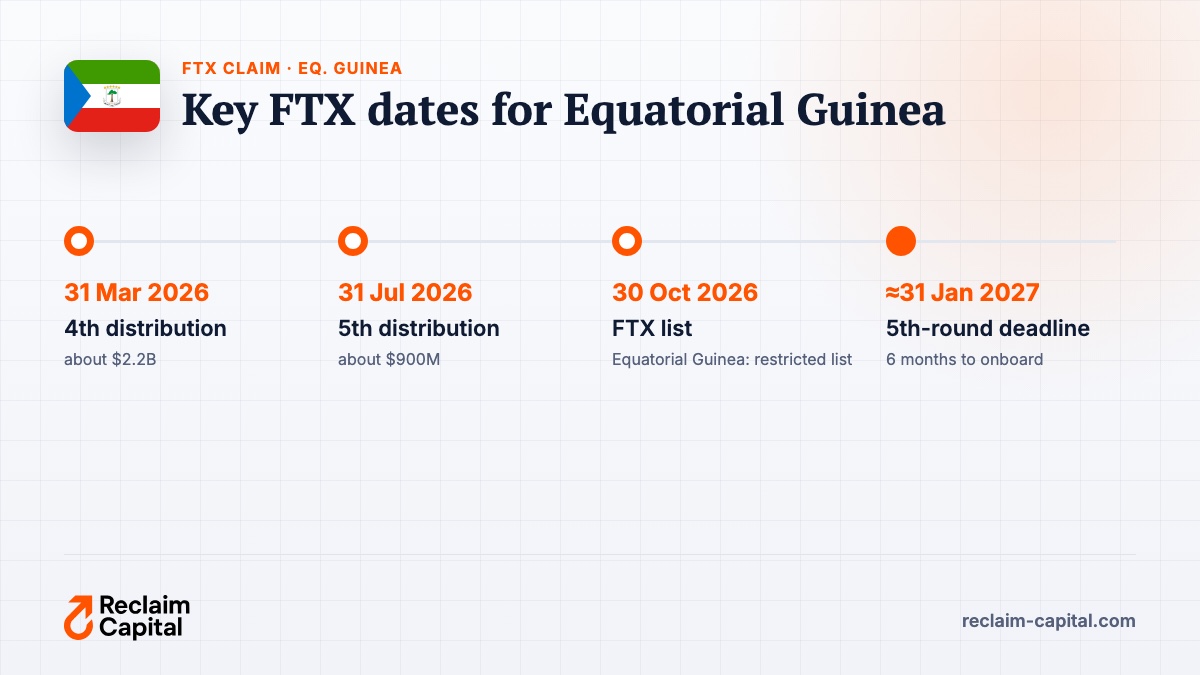
Two recent rounds matter: about $2.2 billion paid on 31 March 2026 and about $900 million on 31 July 2026. Holders of allowed claims not onboarded with a provider within six months of a round may forfeit the right to distributions on the claim, and counted from the July round that limit falls near 31 January 2027. With no provider for the country, onboarding from Malabo or Bata is simply not possible. Read about the July 2026 distribution and what happens to a distribution you missed.
A second risk sits alongside it: a restricted claim may be switched to Disputed, noting the jurisdiction is ineligible, and no court decision yet says how those claims end. FTX’s window to object to claims has also been extended, which we cover in this article on the objection deadline.
Money moving in and out of Equatorial Guinea falls under CEMAC foreign-exchange Regulation No. 02/18, in force since 1 March 2019. Since banks in the zone may not deal in crypto, receiving any crypto-related amount through a local account is not straightforward. Ask your bank what it needs for an incoming foreign transfer before you choose USD.
Selling now turns an open-ended claim into a fixed sum paid in USDT, USDC or, in some cases, USD, while the buyer carries the wait and the court process.
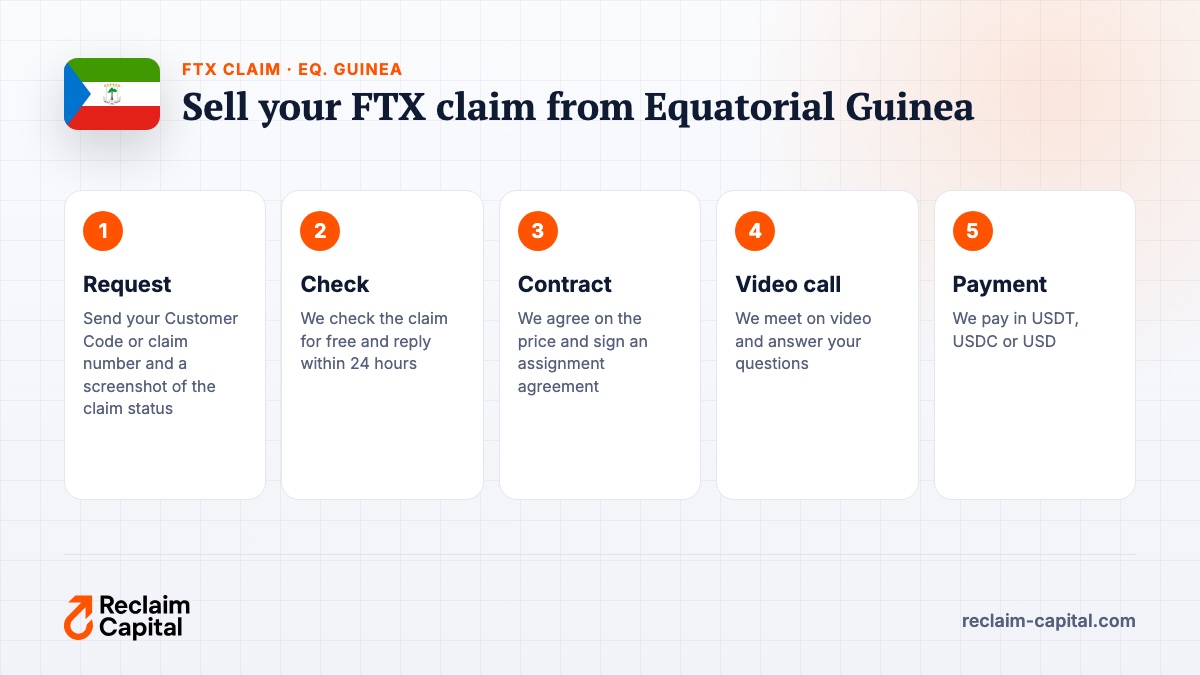
5 steps to sell an FTX claim from Equatorial Guinea
- RequestFill in the form with your Customer Code or claim number and attach an image of the status shown in the claims portal.
- CheckYou get our answer within 24 hours at no cost; we look at the amount, the Allowed or Disputed status and earlier distributions.
- ContractOnce you agree, we prepare an assignment agreement, and you verify your identity with a document such as your passport or the DIP (Documento de Identidad Personal).
- Video callWe meet on video so both sides can see who they deal with and walk through the agreement line by line.
- PaymentFunds arrive in USDT, USDC or, in some cases, USD on the agreed date; the Notice of Transfer is then filed in the case, checked by Kroll and open to objections for 21 days.
Video: how to sell an FTX claim from a restricted-list country
What your FTX claim from Equatorial Guinea is worth
Every offer is worked out for one specific claim: its size, Allowed or Disputed status, payouts already made on it and how ready the paperwork is. A percentage quoted before anyone has looked at the claim would be guesswork, so we do not give one.
Holding the claim from a CEMAC country adds two things a buyer has to price in: an indefinite wait for a provider and the chance of a Disputed status. Settlement in stablecoins or USD also means your amount is fixed in dollars, not CFA francs, so the euro–dollar rate matters when you later convert.
Our own track record: 274 deals closed and $63.3 million in claims purchased.
How to vet a claim buyer from Equatorial Guinea
Everything below can be checked independently, before you send us a single document.
Anyone who wants a seed phrase, a private key or an advance payment is not buying your claim. Be wary of offers in any language, Spanish and French included, that promise to release a restricted FTX payout for a fee.
Because banks in CEMAC stay out of crypto, a deal of this kind rests on the written contract and the public court record. Check that the agreement identifies your claim and that the Notice of Transfer later shows up on the docket.
Due diligence checklist → Transfer of ClaimTransferredView a sample (PDF) ↗
Oleh Chubai
Before signing, ask for the full name of the counterparty, its registration details, the price and the payment terms, and check them against the agreement.

Check your case in 30 seconds
What is your claim status in the FTX portal?
FAQ
Can I legally sell an FTX claim while living in Equatorial Guinea?
Assigning claims is routine in US Chapter 11 and is recorded in the court case. We do not advise on Equatoguinean or CEMAC law; crypto gains may be taxable, and a local adviser can tell you more.
Does the COBAC crypto ban apply to me personally?
COBAC’s 2022 decision targets banks and other institutions under its supervision, not individual creditors. It does mean local banks may not hold or convert crypto for you, so it is worth settling the payment method before signing.
Can I receive payment in CFA francs?
No. We settle in USDT, USDC or, in some cases, USD. Conversion to XAF is done on your side and may fall under CEMAC exchange rules.
I am from Equatorial Guinea, but my KYC address is in Spain. Am I restricted?
FTX looks at the residential address you verified, not at your passport. If that address is in a country with a provider, your case is different; write to us and we will check it.
Why is the whole CEMAC region affected, not just Equatorial Guinea?
FTX has not explained it. All six CEMAC states, including Cameroon, Gabon and Chad, are restricted, and they share one central bank, one currency and one banking regulator.
What documents should I prepare?
Start with your Customer Code or claim number and a status screenshot; an ID such as a passport or DIP comes in only at the contract stage. See the full list of documents.
Are there fees or upfront payments?
None. The check costs nothing, there is no commission, and you never pay us in advance.
Get a free claim check
Reply within 24 hours
- No fees and no prepayment
- Payment in USDT, USDC or USD
- Each case is reviewed individually

