
1. Anatomy of 96.1%: The FTX Fifth Round and the Disputed Reserves Trap
The success of the first four distribution rounds created a false sense of an imminent conclusion among creditors. The high speed of initial distributions was driven by the sale of the exchange's most straightforward assets in a bull market. This was "easy money," unencumbered by complex counterclaims.
But the harsh reality of U.S. law is that a Chapter 11 bankruptcy is not over until the last cent is settled. Now, the liquidation estate faces the most toxic pool of assets. The legal machine has gone into a deep "siege" mode, draining tens of millions of dollars monthly from the estate to pay attorney fees.
2. Hidden Confiscation: What is a "Forfeited Distribution"?
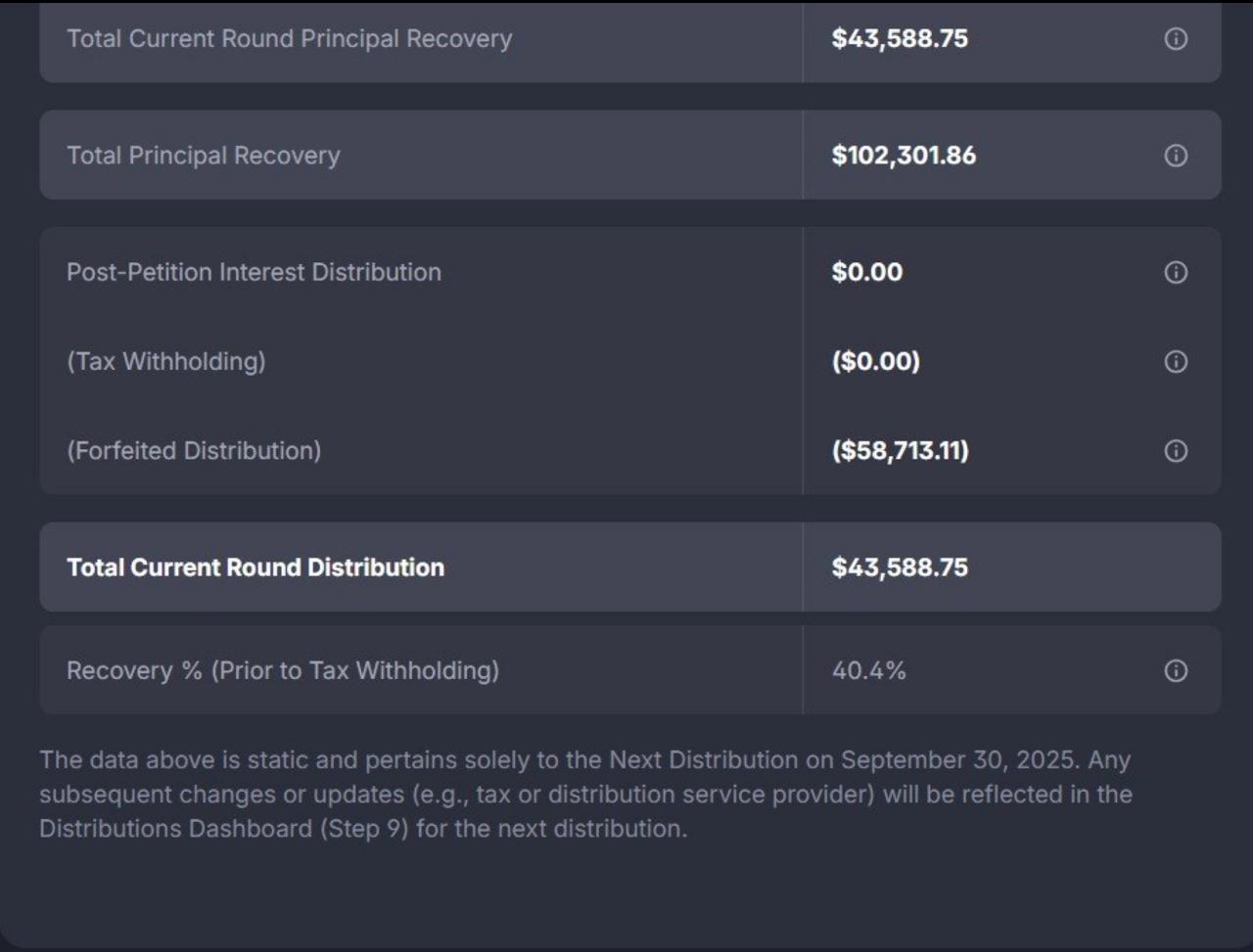
Many investors blindly trust the numbers in their Kroll portal dashboards, expecting the full credited amounts to be deposited. However, at Reclaim Capital, we increasingly observe a frightening precedent: Kroll and PwC are unilaterally deducting funds from creditors' accounts.
Risk of Direct Confiscation and Claim Objections
A formal "late supplement of information" during the verification process is enough for administrators to void over 50% of your current tranche. Are you sure your claim won't be objected to in the Delaware court at the very last moment? If liquidators block the payout, are you prepared to litigate in the U.S. and hire lawyers starting at $1,000 an hour? The system is designed counting on this.
3. The 'Restricted' Trap: Why PwC Bahamas is Blocking Payouts
The situation is exacerbated by a direct jurisdictional conflict. While U.S. courts aim to close the registers, the Bahamian liquidators — PwC Bahamas (JPLs) — are systematically throwing wrenches in the works for creditors from numerous countries. We have confirmed data: accounts of thousands of users are being sent into an endless cycle of Source of Funds (SOF) checks with no deadlines.
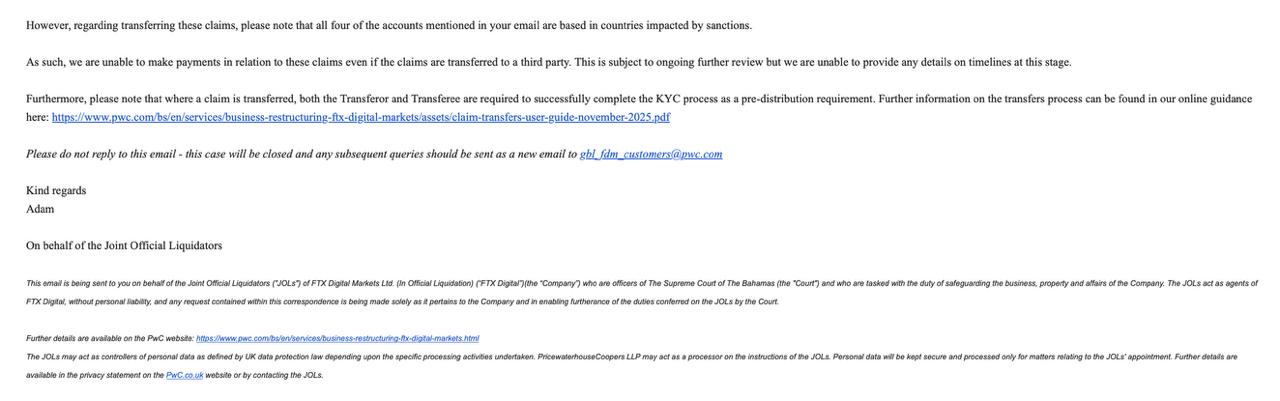
In official responses, PwC support directly evades responsibility, stalling the FTX Fifth Round: "We are unable to make payments... as the accounts are based in countries impacted by sanctions." A logical question arises: what specific international sanctions apply to a regular retail investor from Ukraine, Moldova, Cambodia, and other disputed jurisdictions? There is no logical answer.
Instead, the verification process turns into an endless "verification in progress" status with no specified deadlines. Users from these zones are mass-labeled as 'Restricted' without clear legal grounds. Liquidators are in no rush—it's profitable for them to hold these funds in the pool while you unsuccessfully try to prove the origin of a five-year-old deposit.
The core of the liquidators' strategy is simple: as long as your account is "under review," you don't get paid, and the estate continues to pay legal fees. At Reclaim Capital, we track hundreds of such cases where PwC's roadblocks make receiving payouts through official channels virtually impossible for residents of Restricted zones.
4. Reclaim Capital Forecast: The Micro-Tranche Saga Until 2029
The remaining payouts will turn into an exhausting routine, and the FTX Fifth Round is just the beginning of receiving fragmented capital every six to twelve months. Based on the current dynamics of the Bahamian liquidators and the historical precedent of the Mt. Gox crypto exchange, the Reclaim Capital analytical department has compiled an estimated schedule of future distributions. According to our calculations, the final stage of payouts will stretch until the end of 2029:
| Distribution Round | Projected Date (Reclaim Capital) | Estimated Payout % |
|---|---|---|
| 5th Distribution | July 31, 2026 | 10 – 15% |
| 6th Distribution | March 31, 2027 | 15% |
| 7th Distribution | September 30, 2027 | 15% |
| 8th Distribution | March 31, 2028 | 10% |
| 9th Distribution | September 30, 2028 | 7% |
| 10th Distribution | March 31, 2029 | 5.3% |
| 11th Distribution (Final) | September 30, 2029 | ~4% |
5. The Mathematics of Opportunity Cost: Passivity vs. Reinvestment
By leaving the remaining funds in court, the investor receives a post-petition bonus; however, it barely covers hidden dollar inflation. Effectively, your capital is frozen with minimal real yield. Factoring in the lost opportunity of reinvesting in a bull market, the real purchasing power of this money will drop catastrophically by 2029.
The alternative is an institutional OTC buyout. A one-time realization of claim rights via an Assignment of Claim removes the investor from U.S. court jurisdiction. The received capital in stablecoins, put to work today (via staking, DeFi, or purchasing promising assets), can generate profits that outpace any discount.
However, investors overlook a critical factor: the OTC exit window closes significantly earlier than the official Kroll deadline. The legal procedure of claim assignment under Rule 3001(e) requires sending official notices to the court and takes 3 to 4 weeks. Large funds close their buyout books long before June 16, as buying a claim at the last minute is technically impossible.
- Capital frozen with a yield barely covering inflation.
- Risk of irreversible balance write-offs (Forfeited Distribution).
- Constant compliance pressure and endless PwC SOF checks.
- Threat of Clawback Claims from U.S. courts.
- Full profit realization in stablecoins right now.
- Capital immediately deployed to earn compound interest.
- Legal risks (Claim Objections, U.S. litigation) transferred to the fund.
- Protection from the bureaucratic pressure of Restricted status.
| Evaluation Metric | Passive Waiting Strategy (Court) | Exit via Reclaim Capital (OTC) |
|---|---|---|
| Settlement Horizon | Diluted over 6-11 micro-rounds (2026-2029). | 24–72 hours after legal verification. |
| Legal Risks (Clawback / Objections) | Risk of claim objections and fund blocking by administrators. | Full transfer of legal risks to the fund upon deal execution. |
| Administrative Burden | Regular compliance, KYC updates. | Full asset divestiture. Signing a single Assignment Agreement. |
| Form of Liquidity | Fiat bank transfers (risk of correspondent bank blocks). | Direct stablecoin liquidity to a non-custodial wallet (USDT/USDC). |
Institutional Buyout Roadmap
Caught in the 'Restricted' or 'Verification in Progress' Trap?
Don't let Bahamian PwC liquidators and Kroll compliance void your funds. Protect your capital—get a free legal consultation and express audit of your claim from Reclaim Capital experts. We will analyze your case, assess block risks, and offer legal liquidity options before the hard deadline of June 16, 2026.
Frequently Asked Questions (FAQ)
Is it mandatory to pass FTX Kroll KYC before June 16?
What if I withdrew funds before the bankruptcy? Is there a Clawback risk?
Can I sell my FTX claim if I have already received part of the payouts?
How legal is the OTC claim buyout procedure?
This material was prepared by Reclaim Capital experts. We specialize in managing Distressed Assets in Chapter 11 procedures and cross-border liquidations.
Please note: this publication is purely informational and analytical, based on market trend monitoring and public claims analysis. Possible audit delays are due to the requirements of Bahamian national legislation. We are not affiliated with PwC Bahamas or FTX liquidators.
For a preliminary evaluation request, contact us: @ReclaimCapital

